Picture this scenario: your compliance lead reviews a transcript from a consultation on niche pharmaceutical pricing regulations. The expert’s answer is unusually polished. It’s perfectly structured, covers angles the client never asked about, and reads less like someone recalling their professional experience and more like a briefing document being narrated aloud.
The moderator didn’t flag anything on the live call. But the client did, and now they’re asking pointed questions about the expert’s preparation and whether the insights were genuinely their own.
This is the new grey zone.
An expert using AI on a call doesn’t have to be acting in bad faith. ChatGPT, Perplexity, and a dozen other tools are a browser tab away, and they’re fast enough to generate structured talking points in the seconds between a question and an answer. The accessibility is the problem.
Traditional compliance monitoring was built to catch material non-public information leaks, not to detect whether an expert’s fluency is organic or augmented. Most moderation protocols simply weren’t designed for a world where real-time AI assistance is this seamless.
That gap matters because client trust in expert networks rests on a specific promise: you’re paying for proprietary, experience-based insight from a verified professional. If there’s no way to distinguish between genuine expertise and AI-assisted expert responses, that promise erodes. And it won’t erode quietly.
Buyside clients are already sophisticated enough to notice when something sounds off, even if they can’t articulate exactly why.
The good news? Detection is entirely possible. It requires a deliberate methodology that layers behavioral cues, acoustic signals, and conversational pattern analysis into a structured framework.
This piece breaks down what AI-assisted answering actually sounds like, how to build detection protocols that fit within existing compliance workflows, and why getting ahead of this challenge now is a competitive differentiator rather than a compliance burden.
Why AI-Assisted Expert Responses Are an Emerging Integrity Risk
The expert network model has always sold one thing above all else: access to genuine, experience-based insight from verified professionals. That value proposition isn’t under threat from AI in the abstract. It’s under threat from a very specific operational gap: the inability to distinguish between an expert drawing on years of domain knowledge and one quietly reading from an AI-generated response on a second screen.
This isn’t a hypothetical future problem. It’s a present-day reality that the most forward-thinking networks are already working to address.
How AI Tool Accessibility Has Changed Expert Call Dynamics
Two years ago, using an AI assistant during a live consultation would’ve been clunky. The tools were slower, the outputs less polished, and the effort required to integrate them into a real-time conversation was noticeable. That’s no longer the case.
Today’s large language models can generate structured, topically relevant responses in under three seconds. An expert with a tablet propped next to their monitor, or even a phone face-up on their desk, can receive AI-generated talking points between the end of a question and the start of their answer. The friction is essentially zero.
No typing required in many cases. Voice-to-text input, followed by a near-instant text response, makes the entire loop invisible to a moderator listening on the line.
This is a tooling reality, not a moral indictment. The same accessibility that makes these tools valuable for legitimate research preparation also makes them trivially easy to use during a live call. Expert networks didn’t design their compliance frameworks for this scenario because the scenario didn’t exist at scale until recently.
The Integrity Grey Zone: Reflexive AI Use vs. Deliberate Misrepresentation
Not all AI use during a call carries the same risk. There’s a meaningful difference between two behaviors that look superficially similar.
One is the expert who reflexively checks a specific data point mid-conversation. Maybe they want to confirm a regulatory date or a market figure before stating it aloud. This is comparable to glancing at prepared notes, and most clients wouldn’t object if they knew.
The other is the expert who’s systematically feeding questions into an AI assistant and reading back structured answers on topics that fall outside their genuine expertise. This person isn’t supplementing their knowledge. They’re substituting for it.
The client is paying a premium rate for insight that could’ve been generated by anyone with a browser.
Conflating these two behaviors undermines credible enforcement. A detection framework that treats all AI interaction as equivalent will generate false positives, alienate legitimate experts, and erode trust in the compliance process itself. The goal isn’t to ban every digital reference.
It’s to identify the cases where AI-generated content is replacing the proprietary expertise the client is paying for.
What Clients Are Starting to Ask About Expert Call Quality Assurance
Buyside firms aren’t waiting for networks to figure this out on their own. Hedge funds, private equity shops, and strategy consultancies are increasingly asking direct questions about how expert networks verify the authenticity of the insights they deliver.
These aren’t vague concerns. They’re showing up in RFPs, in vendor review calls, and in post-consultation feedback. The question is pointed: how do you know the expert was actually drawing on their own experience?
Networks that can articulate a structured, credible answer to that question have a tangible advantage in retaining and winning mandates. Networks that can’t will find themselves losing ground to competitors who’ve built detection into their quality assurance workflows. This isn’t about blame.
Existing compliance infrastructure was purpose-built for conflicts of interest screening and MNPI controls. Those capabilities remain essential. But they don’t address the newer question of whether an expert’s fluency on a call reflects genuine domain knowledge or real-time AI augmentation.
The vast majority of experts on any network’s roster provide exactly what clients are paying for: hard-won, experience-based perspective that no language model can replicate. Detection frameworks exist to protect that value, not to undermine confidence in the model. The experts who consistently deliver original insight deserve a system that distinguishes them from the small number who don’t.
Building that system starts with understanding what AI-assisted answering actually looks and sounds like in practice.
Behavioral Signals: How to Detect AI Use During Expert Calls
Detection starts with what humans can actually observe in real time. Before acoustic analysis, before transcript-level review, before any automated system enters the picture, there are behavioral signals that a trained moderator or call reviewer can learn to recognize. These signals aren’t subtle once you know what to look for.
They’re patterns in timing, tone, and topical fluency that diverge from how genuine domain experts typically communicate under live questioning.
No single signal is conclusive. That’s worth stating upfront. An expert who pauses before answering might simply be thinking carefully.
An expert who sounds unusually polished might just be well-prepared. The value of behavioral detection lies in pattern recognition across multiple signals within the same call, not in flagging any one moment in isolation.
Latency Patterns That Suggest an Expert Is Reading AI-Generated Answers
Genuine expert recall has a recognizable rhythm. It includes natural pauses, false starts, self-corrections, and verbal hedging. Phrases like “let me think about that,” “from what I recall,” or “I’d estimate roughly” are markers of someone actively retrieving information from memory.
The cognitive process of recall is inherently imperfect, and it sounds imperfect.
AI-assisted responses produce a different latency signature.
The pattern to watch for is what you might call “pause-then-polish.” There’s a slightly longer initial silence after the question (while the expert prompts or scans a generated response), followed by an unusually fluent, uninterrupted delivery. The answer arrives fully formed.
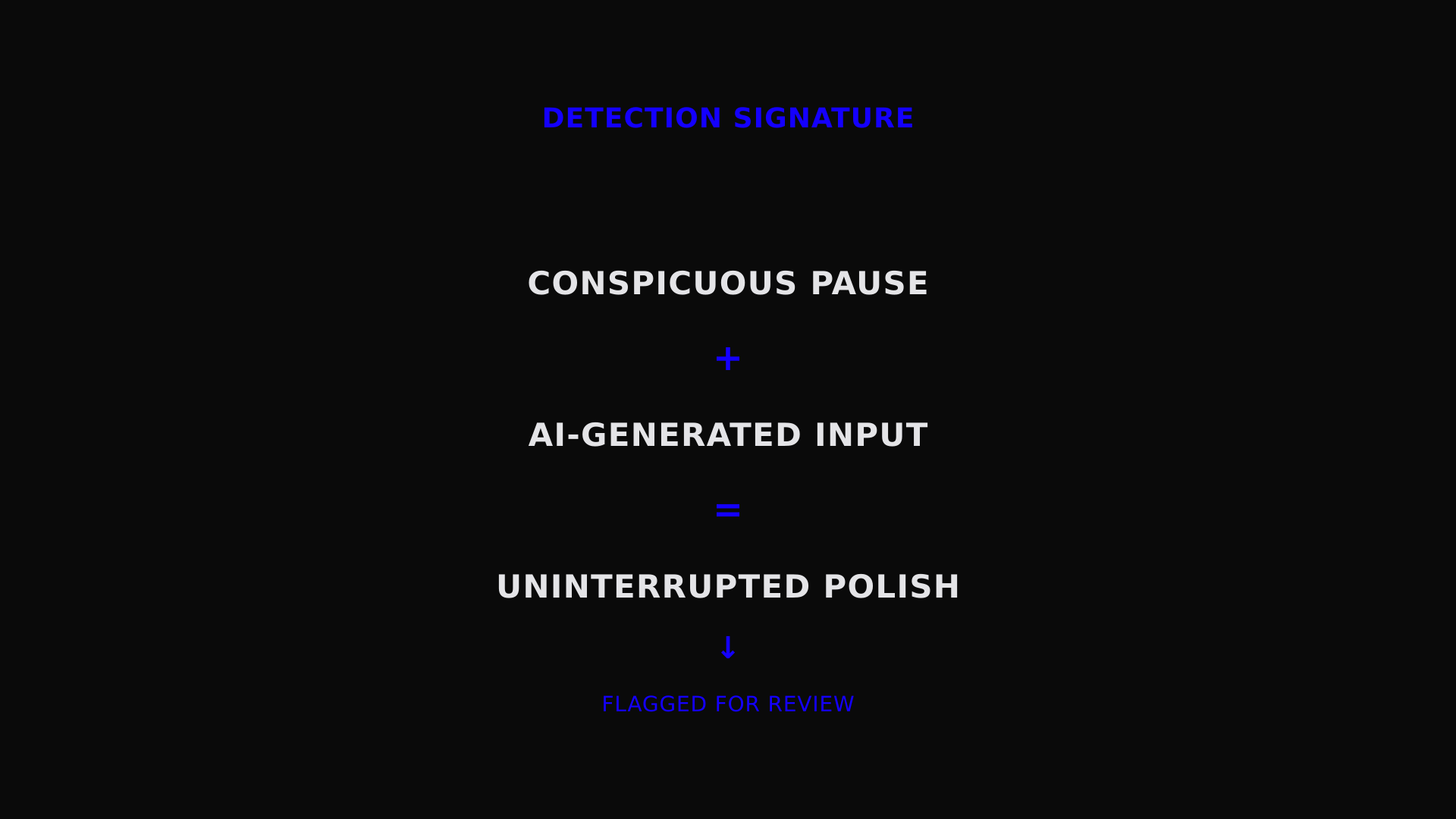
There’s no verbal scaffolding, no mid-sentence course correction, no approximation. It’s the smoothness that stands out, not the delay itself.
This matters because natural expertise rarely presents as perfectly linear. A former VP of supply chain operations answering a question about procurement cycle times will typically talk through the answer, adjusting as they go, referencing specific situations they’ve encountered, occasionally backing up to clarify a point. That messiness is a feature of authentic recall, not a flaw.
When it’s absent, and when the absence follows a conspicuous pause, moderators have a legitimate reason to note the pattern.
Register Shifts Between Spontaneous Recall and AI-Assisted Responses
Register is the linguistic term for the level of formality, structure, and vocabulary a speaker uses. In a natural conversation, an expert’s register stays relatively consistent. They might be casual and anecdotal, or precise and technical, but the baseline holds throughout the call.
When AI is being used selectively, that baseline fractures.
The shift typically looks like this: the expert sounds conversational and spontaneous during early rapport-building and questions in their core area, then pivots to language that’s noticeably more structured, formal, or comprehensive when a harder question lands. The vocabulary may change. Sentence construction may become more complex.
The answer may include enumerated points or systematic framing that doesn’t match how the expert was speaking thirty seconds earlier.
This register shift is one of the most reliable human-detectable signals because it’s hard to fake consistency. An expert who’s genuinely drawing on deep experience will sound like themselves across the full call, whether the question is easy or hard. They’ll hedge more on difficult topics, not suddenly become more articulate.
When fluency and structure spike on specific answers, it’s a signal worth flagging for further review.
Unnatural Fluency on Peripheral Topics as a Detection Signal
Every expert has boundaries to their knowledge. A former regional sales director for a medical device company will have deep insight into channel dynamics, pricing negotiations, and competitive positioning within their territory. Ask them about the company’s R&D pipeline or manufacturing cost structure, and you’d expect hedging, approximation, or a straightforward “that’s outside my area.”
That’s what genuine expertise sounds like at its edges: honest about its limits.
An expert supplementing with AI may not show those limits. Instead, they might provide suspiciously comprehensive answers on tangential topics, with a level of detail and organizational structure that doesn’t match their stated background. The answer isn’t wrong, necessarily.
But it’s too complete, too well-organized, and too confident for someone who shouldn’t have that depth in that area.
This signal is especially useful when cross-referenced against the expert’s profile. If someone screened as a commercial operations specialist is delivering polished, structured commentary on regulatory strategy, the mismatch between stated expertise and demonstrated fluency deserves scrutiny. It doesn’t mean they’re definitely using AI.
But combined with latency anomalies or register shifts elsewhere in the same call, it strengthens the case for escalation.
Why Multi-Signal Pattern Recognition Matters
The critical discipline here is resisting the urge to flag based on any single indicator. Each of these behavioral signals has innocent explanations. Some experts are naturally polished speakers.
Some pause because they’re thoughtful. Some happen to have broader knowledge than their profile suggests.
Detection becomes credible only when multiple signals converge within the same consultation. A pause-then-polish pattern on two answers, combined with a register shift on a peripheral topic, combined with fluency that doesn’t match the expert’s background? That’s a pattern worth investigating.
Training moderators and reviewers to recognize these convergences, rather than reacting to isolated moments, is what separates a rigorous detection capability from a guessing game.
Acoustic and Linguistic Signals in AI-Assisted Expert Responses
Behavioral cues give moderators a real-time detection layer. But some of the most telling signals that an expert is reading from AI-generated content aren’t visible in the moment. They’re embedded in the audio itself and in the linguistic DNA of the transcript.
These signals are harder to catch live, which is precisely why they matter for post-call review.
Acoustic and linguistic analysis turns the transcript into a detection surface. It’s the layer where patterns that slip past even experienced moderators become visible, measurable, and scalable.
Audio Cues: Typing Sounds, Reading Cadence, and Background Noise Patterns
The audio track of an expert call carries more information than most compliance workflows currently extract from it. Three categories of audio signal are worth systematic attention.
First: mechanical sounds. Keyboard typing during a pause before an answer is one of the more straightforward indicators that an expert is interacting with a device. It’s not definitive on its own (people take notes, check calendars, or fidget), but typing that consistently precedes a shift in fluency or register is a meaningful correlation.
The same applies to mouse clicks, trackpad taps, or the faint audio artifacts of a phone screen being touched.
Second: reading cadence. There’s a well-documented prosodic difference between someone speaking from memory and someone reading aloud. Speech generated from recall has irregular pacing, pitch variation, and natural filler words (“um,” “you know,” “sort of”).
Reading aloud produces more even pacing, a narrower pitch range, and noticeably fewer hesitations. When an expert’s delivery shifts from conversational recall to this flatter, more metered cadence mid-call, it’s a signal that the source of their language has changed.
Third: background noise shifts. An expert who’s pulling up an AI assistant on a second device may inadvertently introduce subtle changes in their audio environment. A chair creaking as they lean toward a screen, a brief increase in ambient noise from repositioning, or the faint chime of a notification can all mark the transition from unaided to aided response.
Individually, these are noise. Collectively, when they cluster around the same answers that also exhibit linguistic anomalies, they form a pattern.
Linguistic Markers in Transcripts That Indicate AI-Generated Content
The transcript is where AI-assisted responses leave their clearest fingerprints.
Large language models produce text with structural habits that differ from spontaneous human speech. These habits persist even when an expert paraphrases rather than reads verbatim, because the organizational logic of the response still reflects how the model structures information rather than how a person recalls experience.
Several markers are worth flagging:
- Exhaustive list-based answers. When a question about competitive dynamics produces a neatly enumerated five-point response covering market share, pricing strategy, product differentiation, distribution channels, and regulatory positioning, that’s not how people talk. That’s how models organize.
- Hedged-but-comprehensive framing. Phrases like “there are several key factors to consider” or “it’s important to note that” are characteristic of LLM output. They signal a response that’s trying to sound balanced and authoritative without committing to a specific experiential perspective.
- Uniform structural depth. A genuine expert will spend more time on the aspects they know best and skim or skip what’s peripheral. AI-generated responses tend to give roughly equal treatment to every sub-topic, producing an answer that’s suspiciously well-rounded.
- Vocabulary divergence from the expert’s baseline. If an expert uses casual, industry-specific shorthand for most of the call but suddenly produces a response with formal, textbook-style terminology, the shift is worth noting.
None of these markers alone confirms AI use. But when multiple markers cluster in the same response, and when that response also coincides with the audio cues described above, the signal strengthens considerably.
How Post-Call Transcript Analysis Strengthens AI Detection
Live moderation catches the obvious cases. The expert who audibly types, pauses for ten seconds, then delivers a perfectly structured answer is detectable in real time by a trained ear. But the more sophisticated cases (an expert who pre-generates answers to anticipated questions, or one who paraphrases AI output fluently enough to mask the source) won’t surface during the call itself.
This is where post-call transcript analysis becomes the scalable detection layer.
Systematic transcript review can surface anomalies that no moderator could catch in the moment. Comparing linguistic complexity across different segments of the same call reveals whether an expert’s vocabulary and sentence structure remain consistent or spike on specific answers. Flagging responses where formality, structure, or comprehensiveness suddenly diverges from the expert’s conversational baseline creates a measurable signal rather than a subjective impression.
It’s also possible to compare an expert’s language patterns across multiple consultations over time. An expert who consistently delivers the same level of fluency and structure is likely drawing on genuine knowledge. One whose linguistic profile varies dramatically from call to call, or whose answers on unfamiliar topics read more polished than their answers on core topics, presents a pattern worth investigating.
This kind of analysis doesn’t require real-time intervention. It requires high-accuracy transcripts and the analytical infrastructure to examine them systematically. That’s where transcript quality becomes foundational to detection.
If the transcript itself is riddled with errors from generic transcription vendors that lack domain-specific models, the linguistic signals get buried in noise. You can’t detect a vocabulary shift if the vocabulary wasn’t captured accurately in the first place.
INFLXD’s work in transcript accuracy and quality analysis sits precisely at this intersection. Not as a real-time call monitor, but as the layer that ensures the transcript is reliable enough to serve as a detection surface. When the transcript is accurate, the linguistic signals are there to find.
Building a Layered AI Detection Protocol for Expert Network Compliance
Individual signals, whether behavioral, acoustic, or linguistic, are useful. But signals without a system are just observations. They don’t scale, they don’t create accountability, and they don’t give clients a credible answer when they ask how your network ensures expert call integrity.
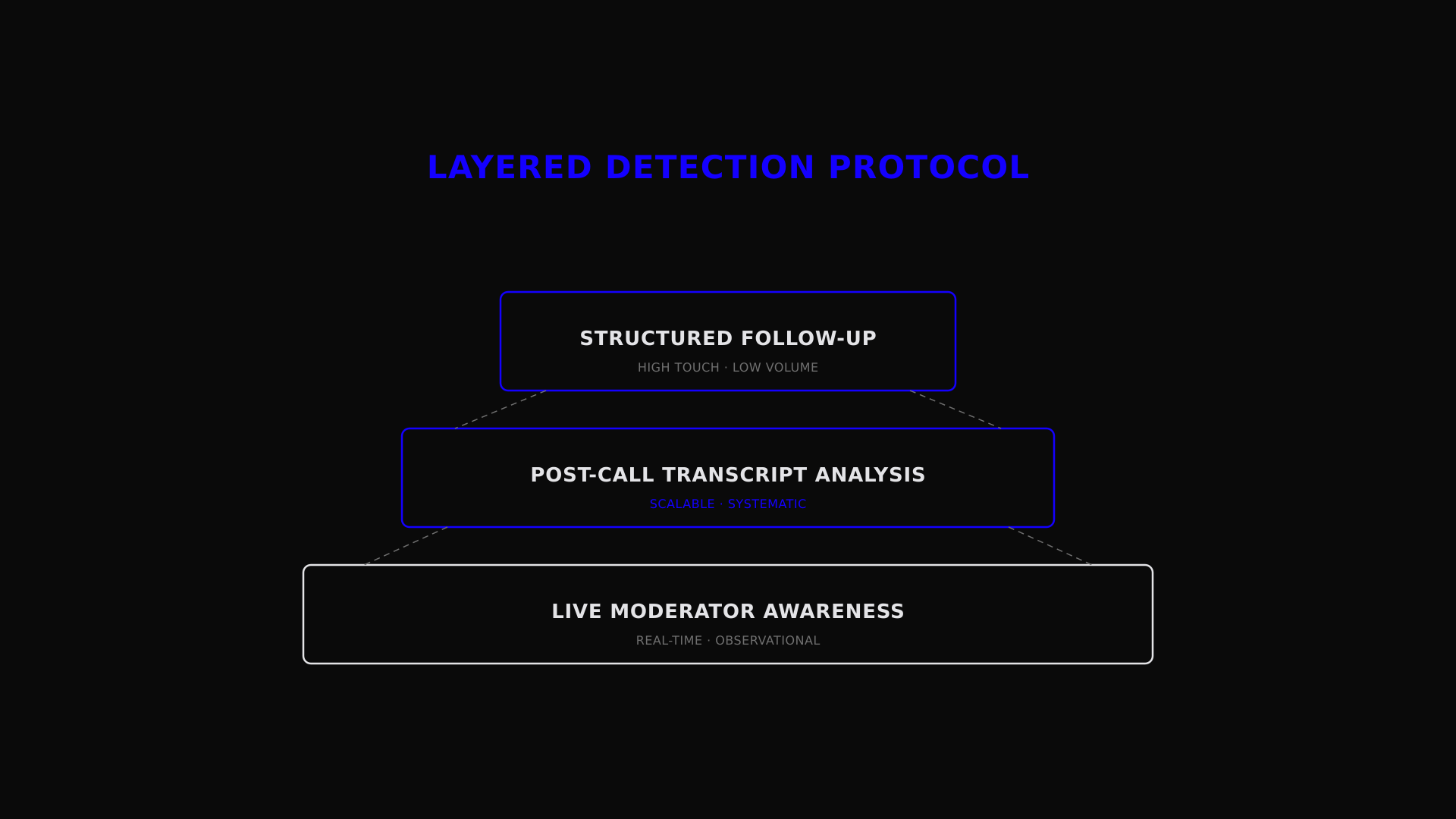
That’s why detection needs to be structured as a protocol with distinct layers, each designed to catch what the others miss. The framework here isn’t theoretical. It’s a practical three-layer approach that fits within existing compliance and quality assurance workflows without requiring expert networks to build entirely new infrastructure.
The three layers: live moderator awareness, post-call transcript analysis, and structured follow-up for flagged engagements.
Real-Time Moderator Training for Live AI Detection Signals
Moderators are the first detection surface, and they’re already on the call. The challenge isn’t adding headcount. It’s equipping existing moderators with the pattern awareness to recognize when something warrants a closer look.
This doesn’t mean turning moderators into interrogators. Confronting an expert mid-call about suspected AI use risks damaging the relationship, derailing the conversation, and creating a hostile dynamic that undermines the consultation’s value for the client. The moderator’s role in this layer is observational, not adversarial.
A lightweight checklist works better than a rigid script. The checklist should cover the core behavioral signals discussed earlier:
- Pause-then-polish patterns: Did the expert go silent for an unusual duration, then deliver a notably fluent, uninterrupted answer?
- Register shifts: Did the expert’s vocabulary, formality, or sentence structure change noticeably between answers?
- Peripheral topic fluency: Did the expert demonstrate surprising depth on topics outside their stated background?
- Audio anomalies: Were there typing sounds, reading cadence shifts, or background noise changes preceding specific answers?
The key discipline is documentation, not intervention. When a moderator notices a convergence of two or more signals, they note the timestamp and the specific concern. That note feeds directly into the second layer.
Training should be practical and example-driven. Short calibration sessions where moderators listen to call segments (both genuine and illustrative examples of AI-assisted patterns) build the ear faster than written guidelines alone. The goal is pattern recognition as a skill, not a set of rules to memorize.
Post-Call Review: Structured Transcript Analysis for AI-Assisted Responses
The second layer is where detection becomes systematic and scalable. Live moderation catches the obvious cases. Post-call transcript analysis catches the rest.
This layer operates on the transcript itself, treating it as a data source rather than just a record. Three analytical approaches work in combination here.
The first is automated linguistic screening. This involves scanning transcripts for structural patterns associated with AI-generated language: exhaustive enumerated lists, hedged-but-comprehensive framing, uniform depth across sub-topics, and vocabulary that diverges from conversational norms. These patterns can be flagged programmatically, creating a triage layer that surfaces the responses most worth human review.
The second is targeted human review of flagged segments. Automated screening generates candidates. Human reviewers assess whether the flagged language genuinely deviates from the expert’s baseline or falls within normal variation.
This step prevents false positives from becoming false accusations.
The third is longitudinal comparison. Over multiple engagements, an expert’s linguistic profile becomes a baseline. Consistency is a strong indicator of authenticity.
An expert who sounds like themselves across five calls is almost certainly drawing on genuine knowledge. One whose linguistic complexity, structural habits, or vocabulary range varies dramatically between consultations presents a pattern that deserves scrutiny.
All three approaches depend on one thing: transcript accuracy. If the underlying transcript is unreliable (if domain terminology is garbled, if speaker attribution is inconsistent, if filler words and hesitations are stripped out by generic transcription vendors that don’t understand the context), the linguistic signals disappear into noise. You can’t measure vocabulary divergence when the vocabulary wasn’t captured correctly.
This is where transcription quality becomes foundational infrastructure for detection, not a nice-to-have.
Designing Follow-Up Questions That Test Genuine Expert Depth
The third layer activates only when the first two layers flag a concern. It’s the highest-touch step, and it’s reserved for cases where the evidence warrants a direct (but respectful) probe of the expert’s knowledge.
Follow-up questions should be designed to test the kind of depth that AI assistants can’t reliably produce. Large language models are good at generating comprehensive, well-organized overviews. They’re poor at producing the specific, personal, contextual detail that comes from lived professional experience.
Effective follow-up questions share a few characteristics. They ask for specifics that aren’t publicly available: “Walk me through how that decision was actually made internally.” They probe for process and reasoning, not just conclusions: “What alternatives did your team consider, and why did you reject them?”
They invite uncertainty and nuance: “Where were you wrong about this, and when did you realize it?” They test temporal evolution: “How has your thinking on this changed since you left that role?”
Genuine experts answer these questions with texture. They mention specific colleagues, describe internal debates, acknowledge mistakes, and offer caveats. Their answers get messier and more specific, not cleaner and more comprehensive.
AI-generated responses move in the opposite direction. They tend toward confident completeness. They rarely express genuine doubt.
They don’t reference specific internal dynamics that aren’t in the public record. When a follow-up probe produces the same polished, comprehensive quality as the original flagged response, the signal is strong.
Framing the Protocol as Quality Infrastructure
One final point on implementation. How this protocol is framed internally matters as much as how it’s built.
If it’s positioned as a surveillance program, it’ll generate resistance from compliance teams, moderators, and experts alike. If it’s positioned as quality infrastructure (a system that protects the value of genuine expertise and strengthens client confidence), it becomes a natural extension of the quality assurance work expert networks already do.
The vast majority of experts on any network’s roster are doing exactly what they’re paid to do. This protocol exists to protect their value, not to cast suspicion on the model. The networks that build this capability now aren’t reacting to a crisis.
They’re getting ahead of an emerging challenge in a way that reinforces the trust their clients already place in them.
Expert Network AI Policies: Defining Acceptable vs. Unacceptable AI Use
Detection protocols are essential. But they’re reactive by design. They catch problems after they’ve already occurred on a call.
The most effective way to reduce the risk of an expert using AI during a consultation isn’t better surveillance. It’s clearer rules.
Right now, ambiguity is the real threat. Most expert networks have robust compliance frameworks covering MNPI, conflicts of interest, and confidentiality obligations. Those policies are specific, well-communicated, and enforced.
But explicit guidance on AI use during live engagements? That’s still a gap in most onboarding and compliance documentation across the industry.
That gap isn’t a failure of foresight. It’s a reflection of how quickly the tooling landscape has shifted. The networks that close it first will set the standard everyone else follows.
Why Ambiguity in AI Use Policies Creates More Risk Than AI Itself
When rules aren’t stated, people make their own. An expert who pulls up an AI assistant to confirm a regulatory date before answering doesn’t think they’re doing anything wrong. And depending on your standards, they might not be.
But without a clear policy, that same expert has no framework for distinguishing between a quick fact-check and systematically feeding questions into a language model to generate structured answers they read back as their own.
The spectrum from reflexive tool use to deliberate misrepresentation (discussed earlier in this piece) only becomes manageable when the boundaries are explicit. Without them, well-intentioned experts operate in a grey zone where their behavior could be perfectly reasonable or a serious integrity issue, depending on who’s reviewing the call.
This ambiguity also undermines detection. If moderators and reviewers don’t have a clear definition of what constitutes a violation, flagging becomes subjective. One reviewer escalates a case.
Another dismisses the same pattern. Inconsistency erodes the credibility of the entire compliance process.
Clear policy eliminates the grey zone. It gives experts a standard to follow, moderators a standard to enforce, and clients a standard to trust.
What an Effective AI Use Policy for Expert Consultations Should Cover
An effective policy doesn’t need to be long. It needs to be specific, proportionate, and communicated before every engagement. Here’s what it should address:
- The core value proposition, stated plainly. The client is paying for the expert’s personal experience, judgment, and domain knowledge. That’s the product. Any behavior that substitutes AI-generated content for genuine expertise undermines the engagement’s value.
- A clear definition of unacceptable use. Reading or paraphrasing AI-generated answers as if they reflect personal expertise. Feeding client questions into a language model during the call to produce responses on topics outside the expert’s genuine knowledge. Using AI to fabricate specificity (dates, figures, competitive details) the expert doesn’t actually possess.
- Acknowledgment that referencing prepared materials is different. Experts who review notes, consult their own prior work, or confirm a specific data point aren’t violating the spirit of the engagement. The policy should distinguish between preparation and real-time substitution.
- Proportionate consequences. First-time violations identified through detection protocols should trigger a direct conversation, not immediate removal from the roster. Repeated or egregious cases (where AI-generated content clearly replaced genuine expertise across multiple engagements) warrant stronger action. Proportionality protects the network’s relationship with its expert base.
- Pre-engagement communication. The policy should be surfaced before every consultation, not buried in onboarding paperwork signed months earlier. A brief, clear reminder at scheduling or in the calendar invitation keeps the standard top of mind.
Most experts will follow the rules when the rules exist. Detection is for the edge cases. Policy is for the 95%.
Policy Clarity as a Client Trust Signal
There’s a competitive dimension here that goes beyond compliance.
When a buyside client asks “how do you know your experts aren’t using AI on calls?”, the strongest answer isn’t “we trust our experts.” It’s a specific, two-part response: here’s our policy defining acceptable and unacceptable AI use, and here’s our detection methodology for identifying violations.
That specificity transforms a vague assurance into a verifiable capability. It tells the client that the network has thought about this problem, defined its terms, and built systems to enforce them. In an environment where expert call integrity is becoming a differentiating concern in RFPs and vendor reviews, that kind of specificity wins mandates.
The best-run networks in the industry are already drafting these policies. Within 12 to 18 months, explicit AI use guidelines will be a baseline expectation from institutional clients, not a differentiator. The window to lead on this is now.
Framing AI Detection as a Quality Differentiator, Not a Compliance Burden
The instinct with any new integrity risk is to file it under compliance. Build the protocol, train the team, check the box. That framing is a mistake here.
Not because compliance doesn’t matter, but because it undersells what this capability actually represents.
Expert networks sell one thing: access to genuine, experience-based insight. Every detection protocol, every policy, every post-call review process described in this piece exists to protect that product. That’s not a compliance cost.
It’s a quality investment in the core asset the business depends on.
The networks that internalize this distinction will position themselves differently in every client conversation that follows.
Why Expert Network Quality Assurance Is a Competitive Advantage
When a multi-strategy fund is evaluating two networks with comparable expert coverage, comparable pricing, and comparable turnaround times, the deciding factor increasingly comes down to trust infrastructure. Can the network demonstrate that the expertise its clients are paying for is genuine? Can it articulate how it ensures that?
Most networks can speak fluently about MNPI controls and conflict screening. Those capabilities are table stakes. But the ability to describe a structured approach to detecting AI-assisted responses on live calls?
That’s new territory, and it’s territory where specificity wins.
A network that’s built a layered detection protocol (moderator training, post-call transcript analysis, structured follow-up for flagged engagements) isn’t just managing risk. It’s demonstrating operational sophistication. It’s telling clients: we understand how the landscape is shifting, and we’ve built systems that keep pace.
That message resonates with institutional buyers who are already thinking about this problem themselves.
Positioning Detection Capability in Client Due Diligence Conversations
How you talk about this matters as much as what you’ve built. Clients don’t want to hear that their expert network is worried about AI on calls. That framing introduces doubt without providing resolution.
The better approach: lead with the framework, not the fear. “We’ve developed a methodology for verifying that the expertise you’re paying for is genuine, and here’s how it works.” That sentence reframes the entire conversation from risk disclosure to quality assurance.
Anticipate where client scrutiny is heading. Due diligence questionnaires from hedge funds, PE firms, and asset managers will start including questions about AI detection protocols. The timeline isn’t five years out.
It’s 12 to 18 months. Networks that have documented answers ready will clear those reviews cleanly. Networks still improvising will find themselves at a disadvantage in competitive evaluations where trust infrastructure is the tiebreaker.
The window to build this capability quietly, before it becomes an industry-wide expectation, is closing. The networks that move now aren’t reacting to pressure. They’re creating a standard that competitors will eventually have to match.
That’s the definition of a differentiator: something you built before it was required, because you understood where the market was going.
The vast majority of experts deliver exactly what clients pay for. A structured detection capability doesn’t undermine that reality. It protects it, and it gives clients a concrete reason to believe in it.
Where Transcript-Level AI Detection Fits in Expert Call Quality Assurance
Everything described in this piece (moderator training, behavioral checklists, acoustic cues, follow-up questioning, AI use policies) works. But none of it scales on its own.
Expert networks process thousands of consultations every month. Even the most well-trained moderator can only be on one call at a time, and manual post-call review of every engagement isn’t operationally viable. The detection layer that actually scales across high call volumes is the transcript itself.
That’s not a nice-to-have observation. It’s the architectural reality of any detection program that needs to cover a full book of expert engagements rather than a hand-picked sample.
How Transcript Analysis Scales AI Detection Across High Call Volumes
Live moderation is high-fidelity but low-coverage. A moderator catches what they catch on the calls they’re staffing. Post-call transcript analysis inverts that equation: it can touch every call, flag anomalies programmatically, and route only the highest-signal cases to human reviewers.
The linguistic markers discussed earlier in this piece (exhaustive enumerated answers, register shifts, vocabulary divergence from an expert’s baseline, hedged-but-comprehensive framing) are all detectable at the transcript level. They’re patterns in text, which means they’re searchable, measurable, and comparable across an expert’s full engagement history.
This is what turns detection from a per-call judgment into a systematic capability. A compliance team reviewing flagged transcript segments is orders of magnitude more efficient than one trying to listen back through raw audio on every consultation. The transcript becomes the primary detection surface, and the audio becomes the backup for confirming what the text already surfaced.
Connecting Transcript Quality to Expert Integrity Signals
Here’s where most detection frameworks hit a wall they don’t see coming: the transcript itself isn’t reliable enough to support the analysis.
Generic transcription vendors that serve expert networks often lack the domain-specific language models needed to accurately capture financial terminology, industry jargon, and the conversational nuances that distinguish genuine expertise from AI-assisted responses. When those vendors clean up speech into polished, grammatically correct text, they’re actively destroying the signals that matter most for detection.
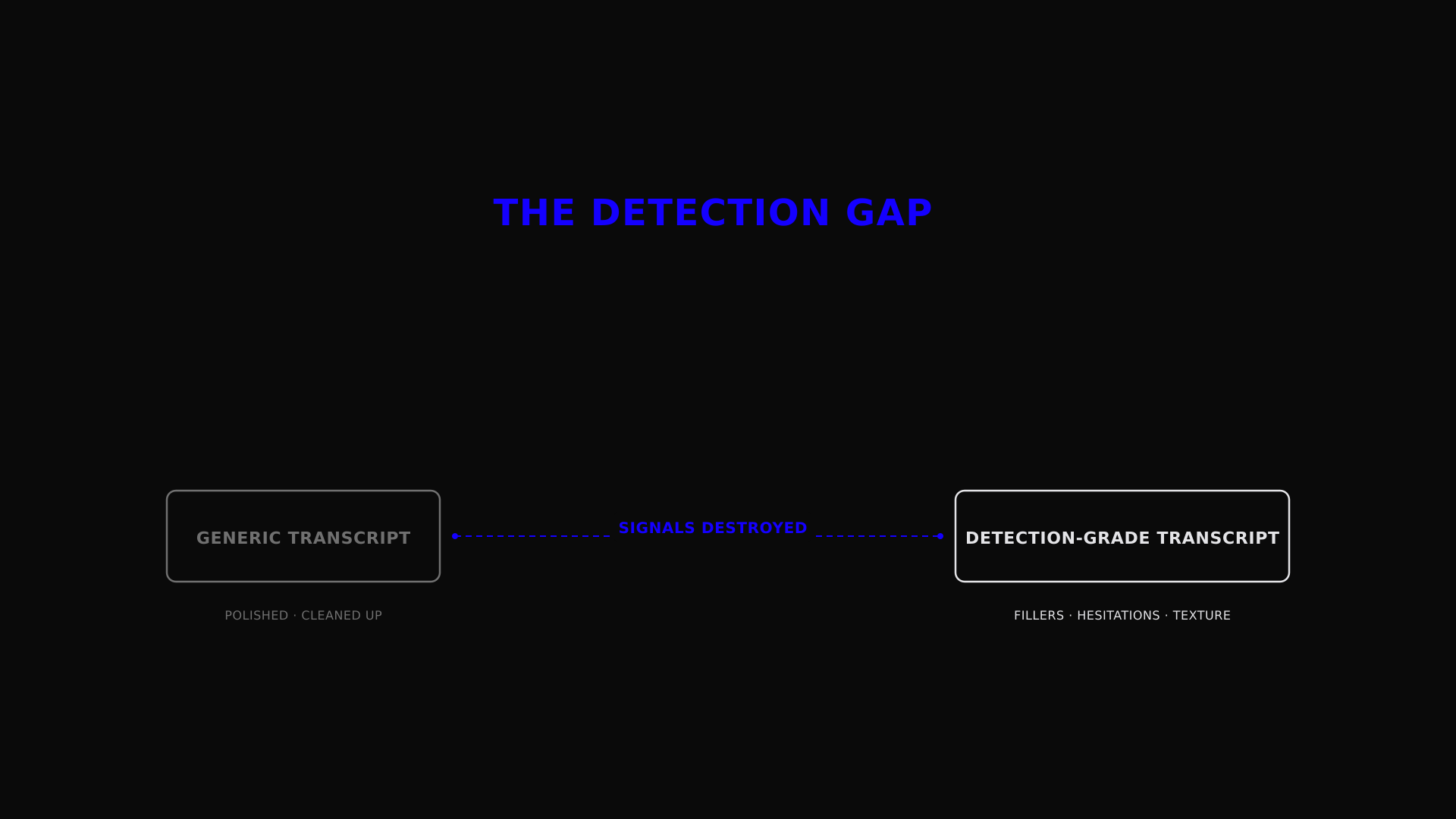
Filler words, false starts, self-corrections, hesitations, mid-sentence pivots. These aren’t noise. They’re the raw material of authenticity detection.
An expert who says “well, I mean, we tried that approach in Q3 and it sort of fell apart because the, uh, the procurement team pushed back” is demonstrating genuine recall. If the transcript renders that as “We tried that approach in Q3 but it failed because the procurement team pushed back,” the linguistic fingerprint of authentic experience has been erased.
The same problem applies to speaker attribution errors, missing segments, and garbled domain terminology. You can’t detect a vocabulary shift if the vocabulary wasn’t captured correctly. You can’t compare an expert’s linguistic baseline across calls if each transcript introduces different errors.
Transcript quality isn’t just about readability for the end client. It’s infrastructure for integrity.
Building the Analytical Foundation Now
INFLXD’s transcript quality and accuracy capabilities sit precisely at this intersection. Not as a real-time call monitor, but as the layer that ensures transcripts are reliable enough to serve as a detection surface. Accurate capture of pauses, register shifts, domain terminology, and conversational texture gives compliance teams the raw material they need to identify when something doesn’t sound like genuine expertise.
As AI tools grow more sophisticated, the signals will get subtler. The experts who use them will get better at masking the patterns. Detection methodologies will need to evolve in response, and the networks that have invested in high-quality analytical infrastructure will be able to adapt.
Those relying on ad hoc review of unreliable transcripts won’t.
The window to build this foundation is now, while the detection signals are still relatively clear and the competitive advantage of having a structured approach is still meaningful.
If your network is thinking about how transcript quality connects to expert integrity and call quality assurance, INFLXD can help you build that foundation. Get in touch to start the conversation.
Protecting Expert Call Integrity: Why Detection Capability Is a Competitive Advantage
The risk isn’t that AI will replace experts. It’s that undetected AI assistance will quietly erode the thing clients are actually paying for: genuine, experience-based insight that no language model can replicate.
This isn’t a problem any expert network should have seen coming sooner. The tools became seamless faster than anyone anticipated, and traditional compliance frameworks weren’t built for a world where an expert can have an AI assistant open on a second screen during a live call. That’s not a failure.
It’s a new reality that demands a new capability.
The networks that build that capability now (layered detection combining trained moderators, acoustic and linguistic analysis, structured follow-up questioning, and clear AI use policies) won’t just reduce integrity risk. They’ll be able to demonstrate to clients, in concrete terms, that their quality controls account for threats most buyers haven’t even started asking about yet. Within 12 to 18 months, this kind of due diligence will be table stakes.
The question is whether you’re building it proactively or scrambling to catch up.
Framing matters here. This isn’t about assuming bad faith from experts. The vast majority deliver exactly what they’re hired for.
It’s about protecting the value of that genuine expertise by having systems that can distinguish it from something a language model generated in three seconds.
Detection at the transcript level is where individual signals become scalable, auditable evidence. That’s where INFLXD fits.
If you want to see what AI-assisted language patterns, fluency anomalies, and quality gaps actually look like in your transcripts, request an INFLXD transcript quality audit. We’ll benchmark a sample of your expert call transcripts against domain-specific accuracy standards and show you exactly where the signals are, so your team knows what to look for and your clients know you’re looking.