There’s a prediction floating around that LLMs could make most websites obsolete within five years. I believe the same could be true for the dominant interfaces in expert networks as they operate today: the direct call and the transcript library.
But this evolution hinges less on the experts themselves and more on a fundamental change in the form factor through which we consume their knowledge. For too long, we’ve focused on the insights and overlooked the interface.
The interface isn't just a delivery mechanism; it is the product. The evolution of this industry is the story of its evolving interfaces, and we appear to be on the cusp of the most significant shift yet.
Trade-Offs
For the last two decades, the expert network industry has been defined by a fundamental trade-off between personalization and scalability, embodied by its two primary form factors.
First is the direct call. This is the interface of pure personalization. It’s a synchronous, one-to-one dialogue where real-time follow-ups and pivots are not only possible but expected.
This premium experience, with expert calls costing anywhere from $500–$1,200 per hour,¹ yields high user satisfaction, often in the 70–80% range. Yet, its strength is its weakness.
Because it’s so personal, its value is trapped by physical limitations—it can only happen in one place, at one time, between two people. It is a high-friction, ephemeral experience that does not scale.
The transcript library was created to solve this. It is the interface of pure scale.
By codifying a call into a searchable document, it makes an insight asynchronous and available one-to-many.
This changes the unit economics of expertise, offering near-zero marginal cost for replication but at the cost of engagement, with satisfaction scores for libraries dipping to 50–60%.
It is a static, non-interactive experience; you are a passive consumer of a conversation that already happened.
Critically, you also lose the serendipitous insights that often emerge in unscripted human calls—the unexpected analogies and tangential pivots that goal-oriented AI might miss.
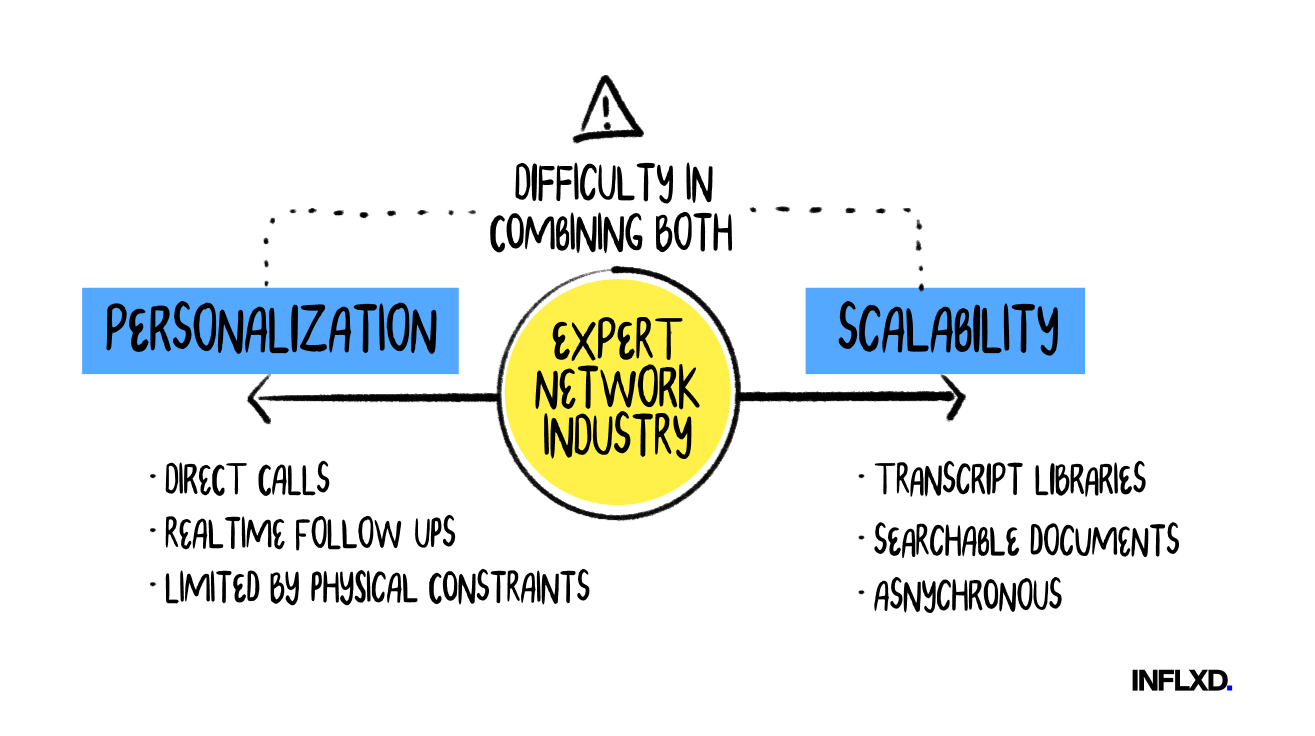
Expert networks have spent years operating on this spectrum, offering high-touch calls for depth and scalable libraries for breadth. Both are compromises.
Getting both in the same interface has been the persistent challenge.
Convergence
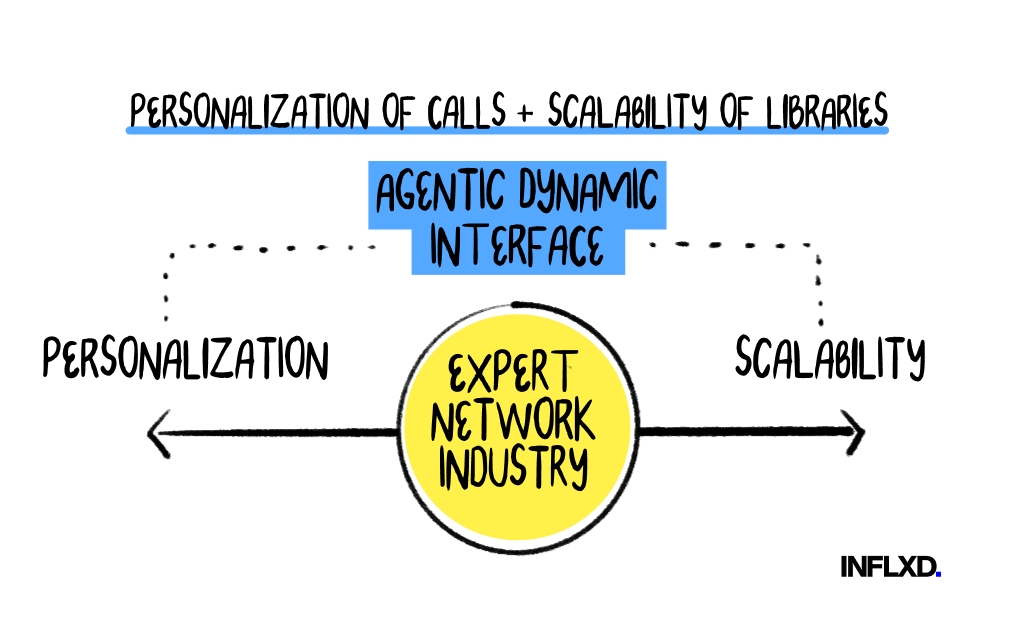
The next form factor that I’m hypothesizing will not be another point on this spectrum; it will likely be one that breaks the trade-off entirely.
This mirrors historical disruptions, like when streaming services obsoleted linear TV by scaling personalization² or when smartphones displaced feature phones with app ecosystems.³
This new interface appears to be agentic and dynamic, offering the personalization of a call combined with the scalability of a library.
Powered by synthetic expertise, this interface is not a static repository you search, but a dynamic entity you converse with.
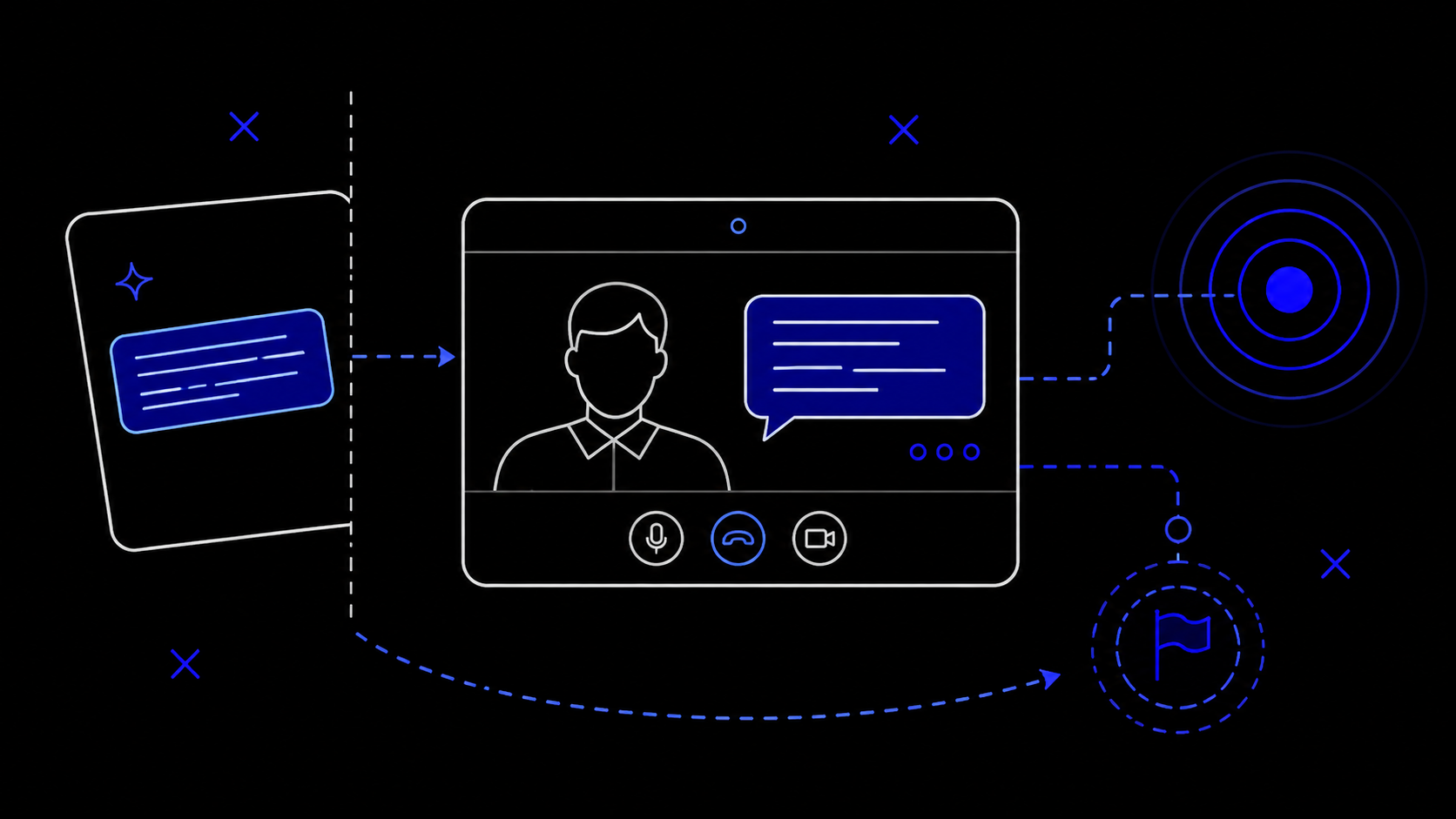
The user experience could shift from querying a database to engaging in an active dialogue, collapsing the experience of direct calls and transcript libraries. The interaction feels personal and bespoke—like a virtual due diligence session or handing a brief to a junior analyst who returns with a structured report almost instantly. Yet, it could happen asynchronously and scale to millions of users simultaneously. The friction that defined the previous form factors dissolves.
Of course, this isn’t a simple proposition.
Real-world pilots of generative AI, like Arbolus's Canopy, are already blending scalability with natural language queries,⁴ but they also reveal persistent challenges with hallucinations and the continued need for human oversight.
As emerging AI research shows, building these agents will likely require a carefully balanced hybrid approach.
To avoid "model collapse"—where recursive training erodes the diversity of insights⁵—networks will need to curate datasets blending real transcripts with synthetic augmentations, perhaps in an 80/20 split, using techniques like diversity sampling to preserve rare knowledge.⁶
From my perspective, the interface must be designed to mitigate hallucination and build trust, likely functioning more as a collaborative co-pilot than an infallible oracle, with safeguards like confidence scoring to flag low-value responses.
Programmatic
A critical implication I'm considering is that the user of this new form factor may not have to be human.
A conversational, agentic interface is, by its nature, programmatic. Its logic could be accessed via an API as easily as through a chat window. This potentially opens the door to an entirely new class of customer: other machines. An investment firm’s proprietary AI might conduct due diligence by querying the network’s synthetic expert directly. A consulting firm’s internal platform could automatically enrich market maps by pulling structured data from the agent.
This evolution could fundamentally alter the industry's economics, pushing it away from per-call fees and toward subscription models that offer unlimited access.
It also seems to shift knowledge transfer from being primarily human-to-human to increasingly machine-to-machine. The product becomes a live, consumable stream of expertise, and the interface must become bilingual—fluent in both human conversation and the structured, reliable language of APIs.
The strategic challenge, then, seems to evolve.
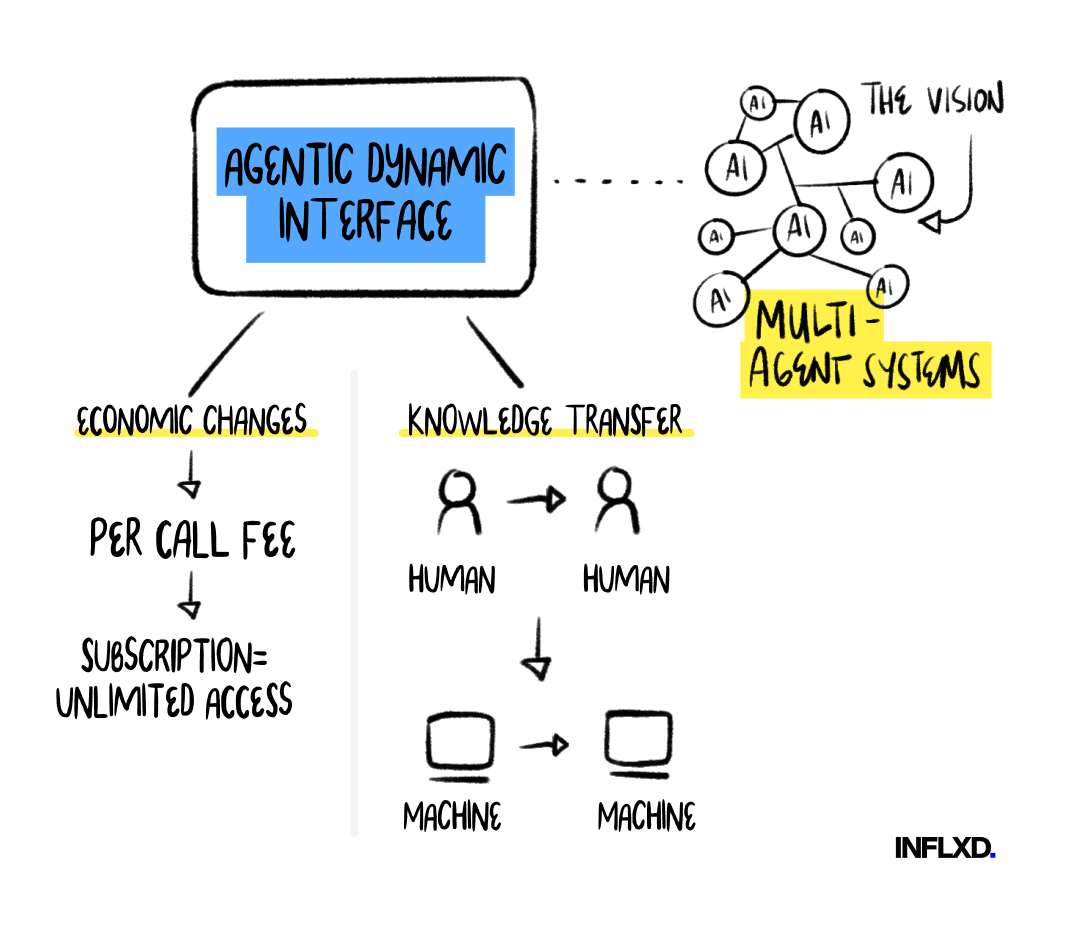
It’s no longer just about building a good user interface, but about creating a robust and trustworthy knowledge API with a clear citation framework to trace AI-generated advice back to verifiable human sources, which is critical for avoiding liability in high-stakes fields like investment due diligence. The vision could even expand to multi-agent systems, where a "team" of specialized AIs collaborate to debate biases and triage answers, enhancing accuracy and credibility.
The question for expert networks is not simply whether to adopt AI, but what form factor they are building for. Optimizing for the call and the library is a strategy for yesterday’s trade-offs. The durable advantage, I believe, will go to those who design for an agentic future.
Because the interface itself is where the next battle will be won.
References
- [1]Inex One. (2023). Getting started with expert networks inex.one/blog/getting-started-with-expert-networks
- [2]PwC. (n.d.). Navigating the decline of linear TV pwc.com/us/en/industries/tmt/library/the-future-of-linear-tv.html
- [3]PCMag. (2013). Smartphones Overtake Feature Phones for First Time pcmag.com/news/smartphones-overtake-feature-phones-for-first-time
- [4]Arbolus. (2023). Arbolus: Changing the Expert Network Industry with Generative AI and ArbolusCanopy arbolus.com/blog/arbolus-changing-the-expert-network-industry-with-generative-ai-and-arboluscanopy
- [5]Ilia Shumailov et al. (2024). AI models collapse when trained on recursively generated data. Nature nature.com/articles/s41586-024-07566-y
- [6]Xiaojuan Wang et al. (2024). On the Diversity of Synthetic Data and its Impact on Training Large Language Models. arXiv preprint arxiv.org/html/2410.15226