A small change in a default setting can sometimes signal a tectonic shift in an entire industry. And we might have just seen the opening move in a high-stakes negotiation.
When Cloudflare announced it would, by default, block AI crawlers from scraping its customers’ websites, it did more than just flip a switch.¹ It fired a starting pistol. This wasn’t necessarily the end of an era, but rather a material initiative from one side of the market to signal that the old terms of engagement are no longer acceptable.
From my perspective, the unspoken rule that public data was free for the taking is now being openly challenged. In its place, a new, more complex economy built on data licensing and strategic access appears to be emerging.
For years, AI models grew powerful by consuming vast amounts of public data, crawling and indexing the web with impunity. This was how they learned. It was how they improved.
That fundamental model of training on public information isn't likely to disappear, but the terms of its continuation are being rewritten in real-time.
The first-order effect of this shift seems simple: it will likely be harder to access the raw data that might be valuable for an AI's output. This introduces a fundamental friction into a system that, until recently, didn’t have one.
Bifurcation
To understand the implications, we have to distinguish between the two primary reasons a Large Language Model (LLM) needs to scrape data. There appear to be two very different use cases.
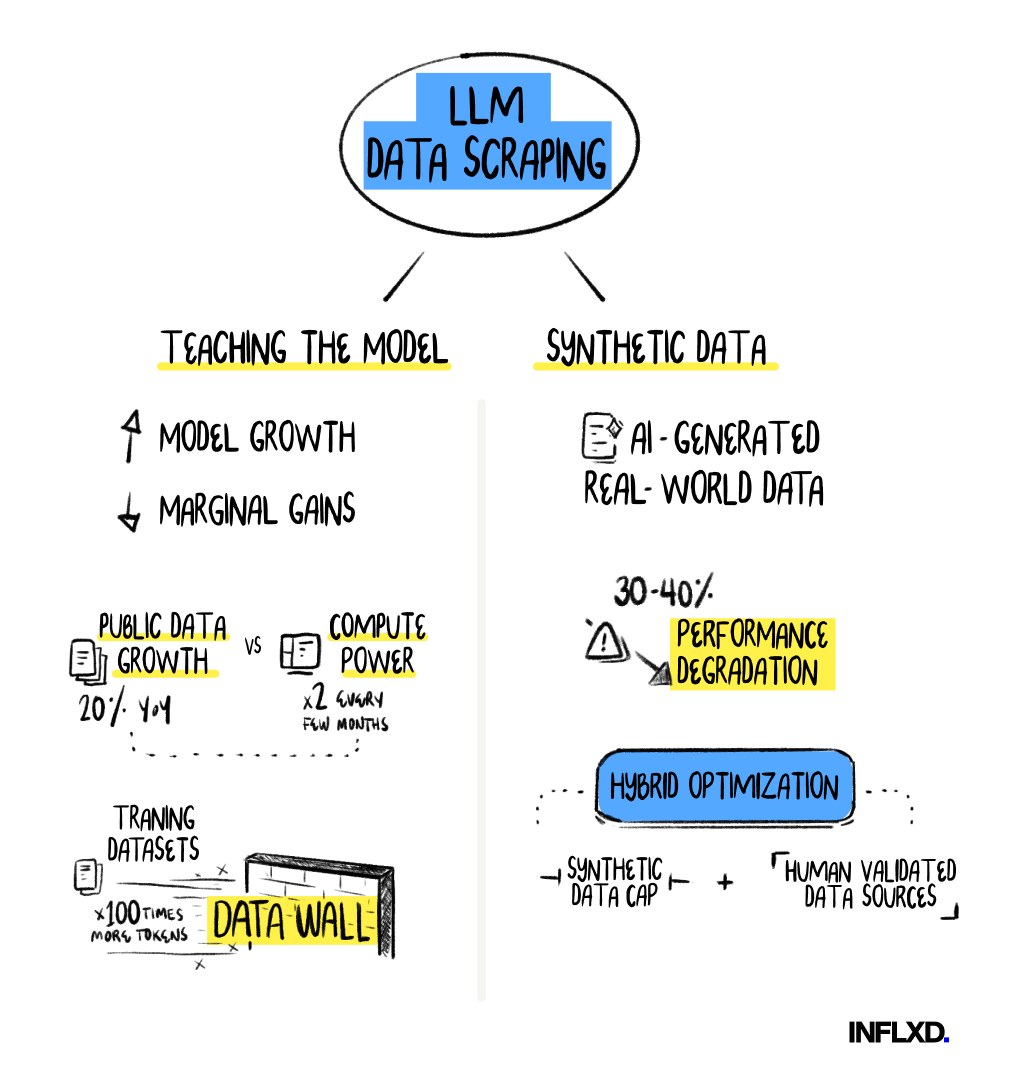
The first is for pre-training—the foundational process of teaching a model how the world works. A compelling argument, supported by foundational research on AI scaling laws, suggests that for the biggest models, we are approaching a point of diminishing marginal returns here.²
The sheer volume of new public data needed to meaningfully improve a frontier model is staggering, with some training datasets already expanding beyond 10 trillion tokens.³
This creates a projected "data wall," where models could require 100 times more tokens for only marginal gains.
This bottleneck on public data forces a pivot. If you can't find enough real-world data, the next logical step might be to create your own.
This is where a workaround like synthetic data comes into the picture. The idea is to use AI to generate artificial data that looks and feels like the real thing.
However, this isn't a silver bullet.
Research from institutions like Stanford and Rice University has highlighted the risk of "model collapse," where an AI that predominantly trains on its own outputs can gradually lose touch with reality.⁴
More recent 2024-2025 experiments show that performance degradation can begin after just a handful of training iterations with as little as 30-40% synthetic data.
The consensus forming in many AI research circles is that the future of pre-training will likely depend on a carefully balanced hybrid.
Optimization may lie in creating a carefully managed portfolio of data—using smart, automated systems to cap synthetics at a safe 20-30% threshold while injecting high-quality "anchor data" from human-validated sources to maintain a connection to reality.
The Dilemma
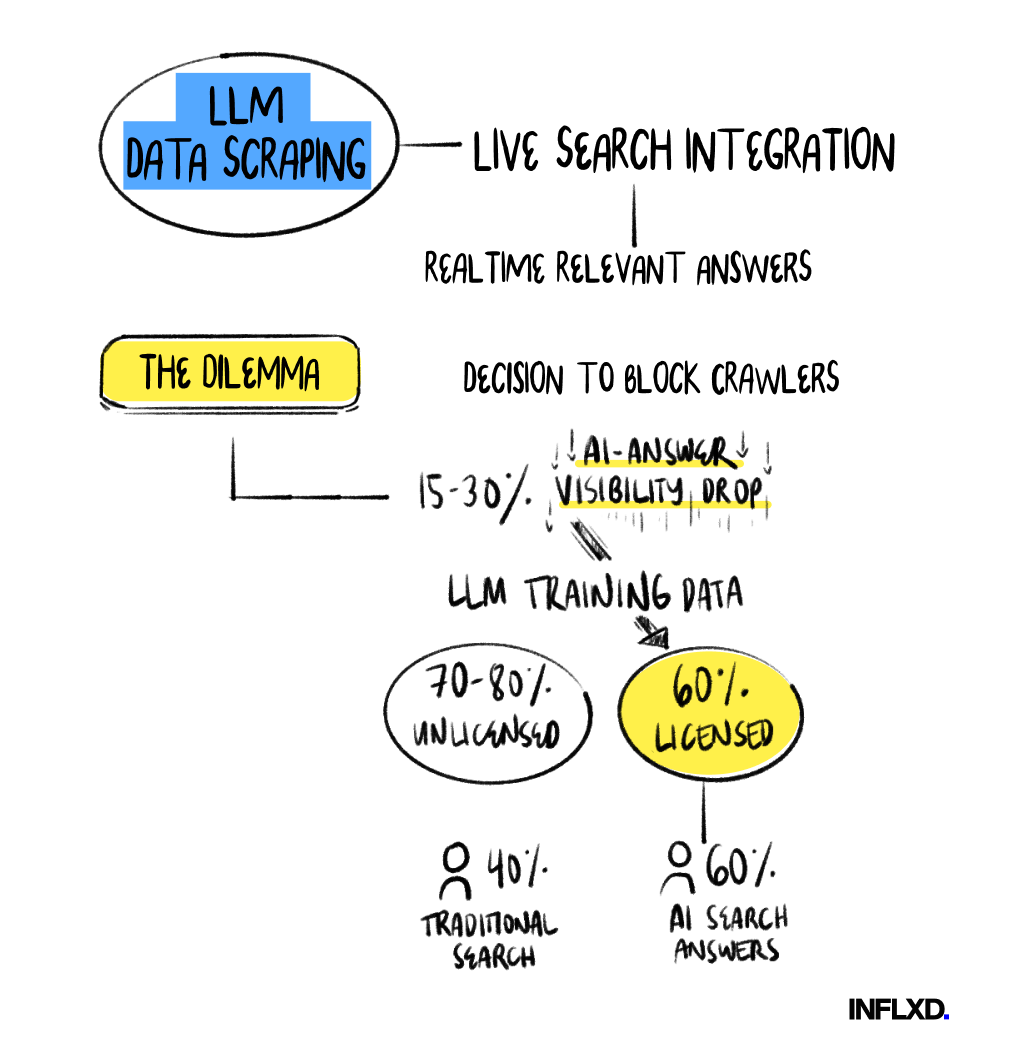
But the second use case for scraping is arguably more important for the day-to-day user: the integration and enrichment of live search results.
This is about providing real-time, relevant answers. And here, the decision to opt out of being scraped creates a powerful dilemma.
While 70-80% of LLM training still relies on unlicensed scraped data, live search integrations are already using 60% licensed sources for real-time enrichment, according to OECD analyses.
If a brand blocks crawlers, it could effectively become less visible.
Recent outcomes show that sites opting out have seen visibility drops of 15-30% in AI-driven search platforms like Perplexity and Grok.
While Google has clarified that blocking its AI-specific crawlers won't impact a site's standing in traditional search, the risk of being excluded from new AI-driven answer engines is real.⁵
By trying to protect their data, brands risk being disinherited from the future of search.
This creates a difficult trade-off: 2025 surveys indicate that while 40% of users will revert to traditional search when AI answers feel "incomplete," a majority 60% still stick with AI for convenience, even if the information is partial.
Synthesis
This tension—the need for high-quality data versus the increasing difficulty of obtaining it—is how new markets are made. We are already seeing this take shape, as major AI firms, facing both technical limitations and legal challenges, have begun striking multi-million dollar data licensing deals.
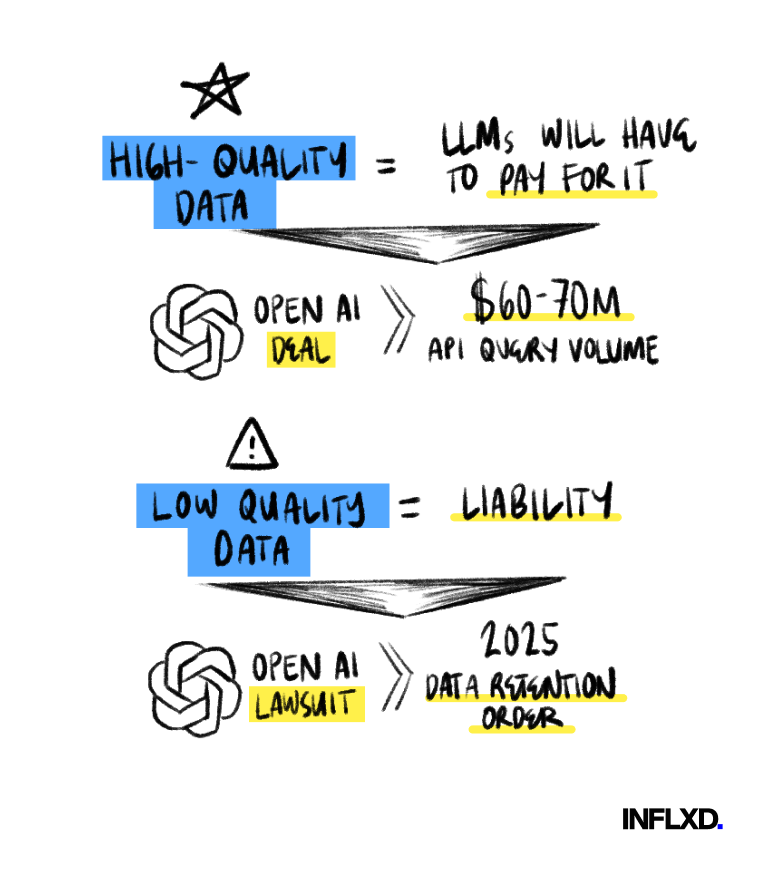
If there is enough friction in accessing free data, LLMs will have to do something they’ve rarely done before: pay for it.
Recent agreements, like OpenAI's deals with Vox Media and Reddit, illustrate this pivot to usage-based terms, with Reddit's deal reportedly valued at $60-70 million annually and including revenue sharing based on API query volume.⁶
Suddenly, a premium is placed on proprietary data sets. We're not just talking about any content; we're talking about a specific kind. AI crawlers primarily consume text, creating immense demand for high-quality written content—especially the transcription of other media—because that is the format most easily indexed.
It also means that low-quality content becomes a liability.
The ongoing NYT vs. OpenAI lawsuit, with its 2025 data retention order, raises the legal risks associated with replicating unreliable information.⁷
This pressure could drive publishers to adopt proactive "detox" strategies, using AI-audited curation to create "certified clean" datasets that can command a premium.
Think about the untapped value in the transcript libraries of expert networks. These are repositories of highly specific, niche conversations. An LLM that could access this information would be able to provide far richer answers, turning those transcripts into valuable, licensable assets.
This, of course, presents a paradox. Opening up these libraries could be seen as cannibalizing their core business. But from my perspective, this is short-term thinking. The real long-game might be to leverage these proprietary datasets to build their own specialized, synthetic experts—a new, defensible product line.
The Publisher's Gambit
Of course, this raises a chicken-or-the-egg problem for content creators.
If an AI has never scraped your website, how can you prove the ROI of investing in deeper content? We don't yet have the data points to understand how to rank in this new world of "AEO" (AI Engine Optimization).
It’s a leap of faith.
However, survey data from 2025 suggests the leap is already happening, with firms like Bain & Company reporting that 80% of users now rely on AI for 40% of their searches and BrightEdge finding that 68% of marketers are already budgeting for AEO.⁸ ⁹
The challenge remains measuring ROI, which could lead to new metrics like an "AI visibility score" to quantify impact.
This leads to two competing scenarios. In the first, a brand decides to monetize its content. But if there are still enough free alternatives, LLMs may simply ignore the paid option.
But what if the opposite happens?
Game-theoretic models predict a tipping point: if 40-50% of quality sources collectively move to a paid model, the performance of free models could degrade by 20-30%, forcing AI firms to the negotiating table.
This creates a dynamic where once enough publishers act, it could establish a new market price for quality data access.
We don’t know how this will play out, but the balance between open discovery and paid quality is a critical dynamic to watch.
Data
The long-term implication I'm considering here is the creation of an entirely new ecosystem where data itself is a product.
The market for AI training data is already projected to become a multi-billion dollar industry.¹⁰ We may need to start educating the world that everyone, whether they know it or not, is sitting on a micro-data-set. If that data is proprietary enough—if it contains unique insights or analysis—it has potential market value.
An activity that was once purely a marketing expense could suddenly become a direct revenue stream. What makes for a valuable proprietary data set? Think of a B2B SaaS company’s podcast series with industry executives—transcribed and published for SEO. Is it now a licensable asset? Or consider a consulting firm's internal repository of anonymized project summaries. That data, once a purely internal knowledge base, now has potential external value.
This could give rise to a tangible economy of data sales, though it's not without socioeconomic risks.
AI inequality models suggest a widening creator gap could emerge, where the top 10% of data creators capture 80% of the value.
Future
For anyone creating content, the opportunity now appears to be threefold.
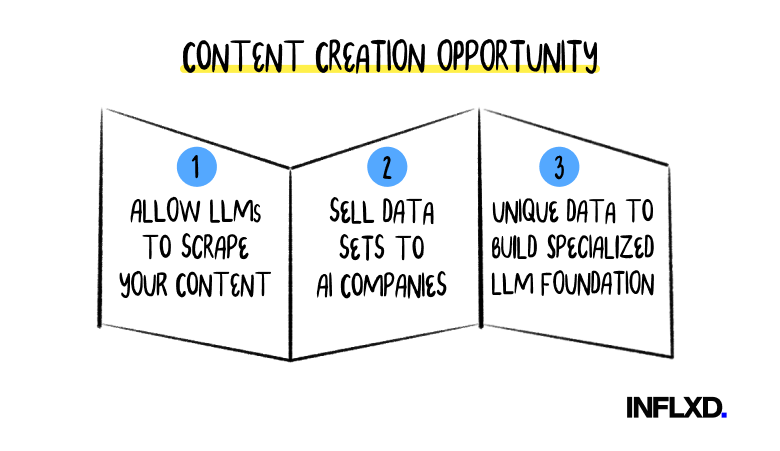
First is discovery: allowing your content to be scraped to appear in LLM results. Second is the possibility of selling your data sets directly to an AI company. And third is using your unique data as the foundation to build your own specialized LLM.
However, this pivot to paid data is not the only possible outcome. Counterarguments from open-source advocates, such as EleutherAI's release of a massive open-domain dataset, suggest that community-curated synthetics and open data initiatives could sustain powerful free models, challenging the formation of data monopolies.¹¹
We are moving from a world where we encouraged everyone to think of themselves as a media brand to a world where everyone might be a data aggregator. Anything you can provide that improves an LLM's response is suddenly something you may be able to monetize, simply because that is where the demand now lies.
The defining question will be how this market evolves as data quality becomes the ultimate differentiator.
Will we see a premium emerge not just for accuracy, but for "neutral" datasets, intentionally built to be free of the biases that can be amplified in proprietary sources?
That remains to be seen.
References
- [1]Cloudflare. (2025). Control content use for AI training with Cloudflare's managed robots blog.cloudflare.com/control-content-use-for-ai-training/
- [2]Stanford Human-Centered Artificial Intelligence (HAI). (2025). Artificial Intelligence Index Report 2025 hai.stanford.edu/assets/files/hai_ai_index_report_2025.pdf
- [3]Epoch AI. (2025). Machine Learning Trends epoch.ai/trends
- [4]Rice University. (2024). Breaking MAD: Generative AI could break the internet news.rice.edu/news/2024/breaking-mad-generative-ai-could-break-internet
- [5]Stan Ventures. (2025). Google to Publishers: Blocking AI Crawlers Won’t Affect Your Search Rankings stanventures.com/news/google-to-publishers-blocking-ai-crawlers-wont-affect-your-search-rankings-2542/
- [6]Search Engine Land. (2025). OpenAI may pay Reddit $70M for licensing deal searchengineland.com/openai-may-pay-reddit-70m-for-licensing-deal-451882
- [7]OpenAI. (2025). How we’re responding to The New York Times’ data preservation demands openai.com/index/response-to-nyt-data-demands/
- [8]Bain & Company. (2025). Consumer reliance on AI search results signals new era of marketing bain.com/about/media-center/press-releases/20252/consumer-reliance-on-ai-search-results-signals-new-era-of-marketing--bain--company-about-80-of-search-users-rely-on-ai-summaries-at-least-40-of-the-time-on-traditional-search-engines-about-60-of-searches-now-end-without-the-user-progressing-to-a/
- [9]GlobeNewswire (BrightEdge). (2025). BrightEdge Survey Reveals 68% of Marketers Are Embracing AI Search Shift As Organizations Look to SEO Teams to Lead globenewswire.com/news-release/2025/06/27/3106575/0/en/BrightEdge-Survey-Reveals-68-of-Marketers-Are-Embracing-AI-Search-Shift-As-Organizations-Look-to-SEO-Teams-to-Lead.html
- [10]Grand View Research. (n.d.). AI Training Dataset Market Size, Share & Trends Analysis Report grandviewresearch.com/industry-analysis/ai-training-dataset-market
- [11]TechCrunch. (2025). EleutherAI releases massive AI training dataset of licensed and open-domain text techcrunch.com/2025/06/06/eleutherai-releases-massive-ai-training-dataset-of-licensed-and-open-domain-text/