Not every comparison in this series is between two transcription companies. This one is between a transcription company and a data annotation company that also offers transcription. That distinction matters more than it might initially appear, and it is the central question procurement teams at expert networks and financial data providers need to answer before a vendor evaluation goes any further.
Sigma AI has 30 years of experience in data annotation, a workforce of 25,000+ trained annotators, and language coverage across 700+ languages and dialects — the broadest of any vendor in this comparison set. For companies building large language models, training speech recognition systems, or running RLHF pipelines, Sigma AI is a credible and well-resourced partner. That is their market, and they serve it well.
Financial services transcription is a different discipline entirely. It requires domain-trained accuracy on specialist financial audio, MNPI-aware compliance architecture, real-time coverage for live earnings calls, and structured data output for downstream research workflows. We write this having evaluated Sigma AI in the context of financial services procurement and finding that the distance between AI training data services and production financial transcription is larger than it first appears. This page explains where that distance lives.
Where AI training data companies run into limits in financial services transcription
Sigma AI's public positioning makes the distinction clear: they describe themselves as the company delivering "human context to accelerate next-gen AI." Their client case studies are global tech giants, governments, and unicorn AI companies. Their service lines — data annotation, RLHF, red teaming, multimodal labelling, conversational AI training — are designed to produce training datasets, not production transcripts for financial research workflows. Transcription is listed as one service within their speech and text annotation offering, sitting alongside intent recognition, dialect assessment, and chatbot training.
The distinction between transcription-for-AI-training and transcription-for-production-use is not academic. AI training transcription optimises for diversity, coverage, and label richness across large volumes. Production financial transcription optimises for accuracy, consistency, compliance, and structured output on specific, high-stakes content. The quality bar, the workflow, the compliance requirements, and the output format are different — and the vendor infrastructure built for one does not automatically transfer to the other.
Transcription is a service line, not a core product.
Sigma AI's website describes transcription under "Speech and Text Annotation" alongside audio annotation, intent recognition, pronunciation assessment, and chatbot training. There is no dedicated financial transcription product, no financial terminology glossary documented, no financial-specific QA process described, and no case study or client reference from the financial services industry published on their site. Their documented client success stories involve launching 24 language teams simultaneously for 2,000+ hours of video transcription — a proof point for scale, but for AI training data production, not for earnings call coverage or expert network interview transcription.
For financial data providers and expert networks evaluating a transcription partner, this matters at a practical level: who is the product manager accountable for your financial transcription workflow? What escalation path exists when a fund name is consistently misheard across a batch of expert calls? What QA scoring system is calibrated to the error categories that create downstream risk in financial research products? These questions do not have documented answers in Sigma AI's public product materials.
No proprietary ASR technology for financial audio.
Sigma AI's transcription service is documented as a human-only workflow — their annotators convert speech to text without a proprietary AI model underpinning the process. This has two implications for financial services buyers. First, it creates a structural cost and speed ceiling: human-only transcription cannot deliver the near-real-time coverage that financial data providers require for live earnings calls, and throughput scales with headcount rather than compute. Second, it means there is no domain-trained AI layer that has been fine-tuned on financial audio to improve accuracy on specialist terminology before human review begins — the financial domain knowledge lives entirely in the individual annotator, whose financial expertise and consistency across files is not publicly documented.
No documented SLAs, accuracy guarantees, or turnaround commitments for financial audio.
Sigma AI's pricing and delivery terms are project-based and negotiated per engagement. Their public site does not document turnaround time options, accuracy SLAs, or quality guarantees for financial audio transcription. For individual AI training data projects — where delivery parameters are scoped at the outset of each project — this model is appropriate. For an expert network processing hundreds of calls per month, or a financial data provider with same-day earnings call publication requirements, the absence of published SLAs is a structural incompatibility with how financial operations actually run.
A vendor without published SLAs is not necessarily a vendor without standards — but it does mean that every quality and delivery commitment must be established and enforced contractually on a per-project basis, with no baseline to reference if performance degrades. For financial operations with fixed publication deadlines, that is a material operational risk.
Quality consistency signals worth investigating.
Sigma AI's Glassdoor rating for transcriber roles is publicly visible and sits at 2.6 out of 5, with 30% of reviewers saying they would recommend the company to a friend. We raise this not as a definitive quality verdict — Glassdoor reviews are self-selected and reflect individual experiences — but because procurement teams at financial services firms routinely examine employer review data as a proxy for workforce stability, training culture, and quality management. A transcription product's consistency depends heavily on annotator satisfaction and retention. This is a question worth raising directly with Sigma AI during any evaluation: what does annotator retention and quality consistency look like for financial audio specifically, and how is it measured?
Why enterprise procurement teams in financial services choose INFLXD
When Sigma AI appears in a financial services vendor evaluation, it is usually because procurement is exploring breadth of language coverage or because someone has conflated AI training data services with production transcription services. The questions that clarify the comparison are always the same: can you match our quality bar on financial audio, can you operate within our compliance environment, and can you meet our turnaround requirements consistently across every file, every week, without a per-project negotiation.
Domain accuracy that compounds over time
INFLXD's editor pool is trained exclusively on financial audio. We maintain proprietary glossaries covering tens of thousands of financial terms — company names, fund names, financial instruments, regulatory language — actively referenced during every editing pass. Our QA scoring system is calibrated specifically to the error categories that create downstream risk in financial research: misheard company names, incorrect figures, speaker misattribution, and terminology approximations that look plausible but are wrong.
Critically, our ring-fenced model means the same editors handle the same client's content over time. They accumulate institutional knowledge — your house style, your most-referenced companies, your sector vocabulary, the speaker patterns of your most frequent experts. That compounding knowledge effect is not available from a project-based annotation model where different annotators handle each batch.
We also bring a proprietary AI layer that Sigma AI's model does not include: AI fine-tuned on financial audio that processes content before human review begins. This means the most common financial terminology errors are resolved before an editor sees the file, the human review is focused on the genuinely difficult content, and the overall accuracy and throughput both improve relative to a human-only workflow.
Total cost of ownership, not project cost
Sigma AI's project-based pricing means every engagement is a fresh negotiation. Volume, turnaround, quality requirements, language, and format all need to be scoped and priced individually. For an expert network processing a consistent monthly volume of calls across multiple languages, that per-project overhead is real operational friction. We do not publish our pricing here, but we do offer transparent, consistent rate structures with volume tiers — not project-by-project negotiation — and our SLAs are contractually committed, not estimated at project scope.
The deeper total cost of ownership question is the same one that applies across this series: what happens after the transcript arrives? A transcript that requires significant internal editing before it is usable in a research product — correcting financial terminology, fixing speaker labels, verifying figures — is not cheaper than a transcript that arrives ready to use, regardless of the per-unit price. Domain-specialist human transcription with a proprietary financial AI layer produces a different baseline accuracy on specialist content than general-purpose annotation workflows, and that difference is where the total cost calculation shifts.
Operational continuity without per-project renegotiation
We ramp to full operational capacity for a new enterprise client in approximately six weeks: style guide training, technical integration, ring-fenced team assignment, and capacity build included. After that, your volume is handled consistently, within agreed SLAs, by the same team — without a new project negotiation every time your audio volume changes or a new language requirement emerges. For expert networks whose call volumes spike during earnings seasons or when a new sector programme launches, operational continuity without commercial friction is a meaningful advantage.
The structural gaps that matter most in financial services
Multilingual production transcription — breadth vs. financial domain depth
For expert networks: Sigma AI's 700+ language coverage is the broadest of any vendor in this comparison — a genuine and significant capability for AI training data production across under-represented languages. For expert network production transcription, the relevant question is not language count but whether the transcription in each language is calibrated for financial domain accuracy, delivered with consistent QA to financial standards, and supported by a financial-specific glossary. None of these are documented for Sigma AI's service. INFLXD's 14+ language coverage is narrower, but each supported language is backed by editors trained on financial audio and financial QA processes. Code-switching support — calls that shift between languages mid-conversation, routine in global expert networks — is not publicly documented for Sigma AI.
For earnings call providers: the issue is real-time coverage and SLA consistency. Sigma AI does not publicly document a real-time or near-real-time transcription capability. Their human-only model has an inherent throughput ceiling that makes sub-hour turnaround on live earnings calls structurally difficult without a documented NRT technology layer. INFLXD's proprietary NRT is purpose-built for live earnings call coverage with self-correcting financial entity recognition.
MNPI compliance architecture for financial audio
Sigma AI holds ISO 27001 and SOC 2 Type II certifications — robust general enterprise security credentials that reflect appropriate investment in information security. Their public security documentation describes GDPR compliance, data minimisation practices, and a privacy-first approach to AI training data. These certifications are appropriate for their core market.
MNPI-specific flagging and scrubbing controls for financial audio are a different category. INFLXD's architecture includes:
- End-to-end AES-256 encryption
- Closed-loop platform — audio cannot be downloaded outside the secure environment
- Fully chunked transcript delivery — no individual sees a complete document at any stage
- Ring-fenced editor teams assigned per client
- MNPI compliance flagging built into the workflow
- Configurable data retention with client-controlled deletion
- Professional liability insurance
None of these financial-services-specific controls are described in Sigma AI's public product materials. Their compliance posture is designed for AI training data workflows — where the primary risks are data privacy and model training governance — not for financial audio containing material non-public information, where the risks are insider trading exposure, regulatory breach, and client confidentiality. These are different compliance environments, and the controls appropriate for one do not automatically satisfy the other.
Real-time transcription for live earnings coverage
INFLXD's proprietary Near Real-Time technology is built for live earnings call coverage: self-correcting on financial entity terminology as the call progresses, with publication-ready output available within minutes of call completion. This is a product capability, not a service configuration — it requires a domain-trained AI model, not just a faster human workflow.
Sigma AI's human-only transcription model does not publicly document a real-time or near-real-time capability. The throughput of a human annotation workflow has an inherent ceiling that is inconsistent with the sub-hour publication requirements of financial data providers whose earnings call products compete on speed. For this use case, the absence of a proprietary ASR layer is a structural constraint rather than a configuration gap.
Beyond transcription: what a strategic partner looks like
Metadata and entity enrichment
INFLXD delivers structured data alongside every transcript: named entity recognition with human validation, company mentions disambiguated and contextually verified, word-level timestamps enabling audio snippet retrieval, and structured JSON ready to feed RAG pipelines, knowledge platforms, or AI search interfaces. Sigma AI's annotation services include entity tagging and NLP labelling — but these are described as AI training data outputs, designed to label datasets for model training, not as production metadata enrichment for financial research products.
Compliance workflow augmentation
We provide a first pass on MNPI flagging and content scrubbing — redaction of analyst names, expert names, or other identifiers based on your specific requirements. We augment the compliance team's workflow meaningfully, so your reviewers are triaging flagged items rather than reading every transcript end-to-end. Financial compliance workflow integration is not described in Sigma AI's publicly available service documentation.
A dedicated financial transcription partner, not a project vendor
Sigma AI's model is project-based: each engagement is scoped, staffed, and delivered as a discrete project. That model is appropriate for AI training data, where project scope, volume, and requirements vary significantly between clients. For financial services transcription, the most valuable vendor relationship is a persistent partnership — ring-fenced team, accumulated institutional knowledge, consistent quality against agreed SLAs, and a commercial relationship that scales with your audio volume without renegotiation. INFLXD also offers a co-marketing and business development partnership model for expert network and financial data provider clients. Sigma AI does not publicly describe an equivalent.
Side-by-side comparison
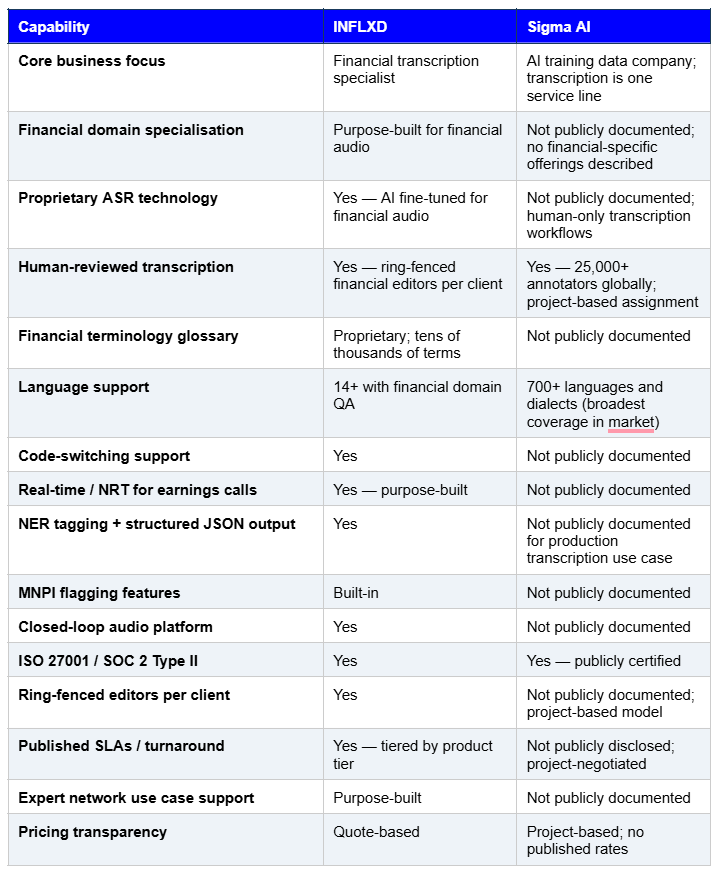
Sigma AI holds ISO 27001 and SOC 2 Type II certification — appropriate for their AI training data market. 'Not publicly documented' entries reflect capabilities not described in Sigma AI's public website or service documentation as of early 2026 for the production financial transcription use case. Buyers should verify directly with Sigma AI.
When Sigma AI is the right choice
Sigma AI is a well-resourced, credible partner for organisations building AI products that require large-scale, multilingual training data. If your organisation needs 700+ language coverage for speech data collection, diverse audio annotation for ASR training, RLHF data pipelines, red teaming, or multimodal labelling for AI model development — Sigma AI's scale, cultural calibration expertise, and annotator depth are genuine competitive strengths that few vendors can match.
The comparison shifts when the requirement is production financial transcription — transcripts consumed directly by analysts, fed into research products, or published as data feeds. The financial domain specialisation, MNPI compliance architecture, real-time coverage capability, structured output for downstream AI workflows, and persistent ring-fenced team model that financial services buyers require are not described in Sigma AI's public product materials. The distance between AI training data production and production financial transcription is wider than the word "transcription" in both descriptions might suggest.
Frequently asked questions
What does Sigma AI actually do, and is transcription their core offering?
Sigma AI is an AI training data company with 30+ years of history in data annotation. Their core business is providing human-labelled training data for AI models — annotation, RLHF, red teaming, speech data collection, and multimodal labelling for companies building generative AI and LLM products. Transcription is one service within their speech and text annotation offering, positioned primarily as a tool for producing AI training datasets rather than as a standalone production transcription service. Their published client work reflects global tech companies and governments, not financial data providers or expert networks.
Does Sigma AI have any financial services specialisation?
Sigma AI's public website and service documentation do not describe financial services specialisation, financial terminology glossaries, earnings call transcription capabilities, expert network workflow support, or MNPI compliance features. Their domain expertise, as publicly described, lies in cultural calibration and localisation across 700+ languages — a strength for AI training data that does not automatically transfer to the specific accuracy requirements of financial audio transcription.
Sigma AI has 700+ languages — doesn't that make them the strongest multilingual option?
700+ language coverage is the broadest of any vendor in this comparison and is a genuine capability advantage for AI training data production across under-represented languages. For production financial transcription, the relevant measure is not language count but financial domain calibration within each supported language. INFLXD supports 14+ languages with human reviewers trained specifically on financial audio, financial terminology, and the speaker dynamics of expert network and earnings call content — and supports code-switching within a single recording. Neither financial domain calibration across languages nor code-switching is publicly documented for Sigma AI's transcription service.
How does Sigma AI's compliance posture compare to INFLXD's for financial audio?
Sigma AI holds ISO 27001 and SOC 2 Type II certifications and is GDPR compliant — appropriate enterprise security credentials for their AI training data market. MNPI-specific compliance controls for financial audio are a different category: closed-loop audio architecture, chunked delivery preventing any individual from seeing a complete document, MNPI flagging workflows, and ring-fenced editor teams per client. These controls are not described in Sigma AI's public security documentation. For expert networks and financial data providers where MNPI exposure is a daily operational reality, these distinctions matter in legal and procurement review.
Can Sigma AI commit to turnaround SLAs for financial audio transcription?
Sigma AI's delivery model is project-based and negotiated per engagement. Their public documentation does not describe fixed turnaround options, accuracy SLAs, or quality guarantees for financial audio transcription. INFLXD offers contractually committed SLAs across tiered turnaround windows — 1-hour, 4-hour, 12-hour, and 24-hour — with volume capacity built in from day one of the partnership. For financial operations with fixed publication deadlines, the difference between a per-project estimate and a contractually committed SLA is operationally material.
What should I ask Sigma AI directly if they come up in an evaluation?
Three questions worth raising directly: First, can they provide guaranteed turnaround times and accuracy SLAs for financial audio specifically — not project estimates, but contractual commitments? Second, what is their financial terminology accuracy rate and what domain-specific glossaries do they maintain for expert network content? Third, what does annotator retention and quality consistency look like for financial audio — their Glassdoor rating for transcriber roles is publicly visible at 2.7/5, and it is a reasonable proxy question for workforce stability and quality management. How they answer these questions in a live evaluation will tell you more than any marketing document.
How quickly can INFLXD onboard compared to Sigma AI's project-based model?
INFLXD onboards new enterprise clients to full operational capacity in approximately six weeks: style guide training, technical integration, ring-fenced team assignment, and capacity build. After that, your volume runs consistently within agreed SLAs — no per-project renegotiation when call volume changes or a new language requirement appears. Sigma AI's project-based model means each engagement is scoped individually. For financial operations that need a persistent, reliable partner rather than a series of discrete projects, that structural difference is worth considering from the outset.
Test us on your hardest files
The most reliable way to evaluate any transcription vendor is on your own content — specifically the content that gives your current vendor trouble. Send us five of your most challenging recordings: heavy accents, mixed languages, dense financial terminology, multiple speakers. We will return them within 24 hours across three quality tiers — AI-only, AI-assisted, and Human Perfect — so you can assess accuracy, formatting, and turnaround directly against what you are getting today.
No commitment. No generic sample audio. No sales process before you see the output.