If you're evaluating transcription vendors for earnings calls, expert network transcripts, or compliance-sensitive financial audio, this page exists because we've been on the other side of that decision many times over.
We don't write this as outsiders. We write it having competed in formal RFP processes against Rev, traditional BPOs, and other transcription providers — evaluated side by side, on the same audio files, scored against the same criteria. When procurement teams at major expert networks and financial data providers run champion-challenger evaluations, the gaps between purpose-built financial transcription and general-purpose platforms surface fast.
That's not a tagline. It's the reason this page exists.
Why general-purpose transcription breaks down in financial services
Rev is a well-regarded platform. For podcasts, internal meetings, and general business content, it delivers. The problems surface when the audio gets harder, the languages diversify, and the compliance stakes go up — which is the default in financial services.
Here is what we see repeatedly when enterprise buyers stress-test general-purpose transcription vendors against purpose-built alternatives:
Mixed-language calls get mishandled.
An expert in Tokyo starts a call in English, shifts to Japanese for three minutes of technical detail, then comes back to English. A consultant in Geneva moves between French and English mid-sentence. This is routine in global expert networks. Most general-purpose transcription platforms require you to select a single language at submission. If a call contains segments in multiple languages, the non-selected language is either dropped, garbled, or annotated as "(speaking a foreign language)" rather than transcribed. Rev's own help center confirms that for mixed-language files, non-English dialogue in a human transcription order will be noted with a timestamp but not transcribed. For expert networks with international coverage, this creates a significant gap in the output.
Human-reviewed transcription is limited to English.
Rev offers AI transcription in 37+ languages, and global subtitles that translate English video into 15+ languages. But their human transcription service — the tier that delivers 99%+ accuracy — is English-only. AI-only output without human review is rarely sufficient for compliance-sensitive financial content where a misheard figure, a wrong ticker, or a speaker misattribution creates real downstream risk. If your expert network operates internationally, you will need a second vendor for non-English human-reviewed work, which means fragmented quality standards and additional operational overhead.
Domain-specific accuracy gaps emerge on financial content.
The 99% accuracy claim most platforms advertise is measured on clean, single-speaker, native-English audio. The real test is what happens on a 45-minute expert call with a heavy accent, multiple speakers, dense financial terminology, and technical jargon — the kind of content that makes up the majority of expert network and earnings call work. General-purpose transcription platforms staff from broad freelancer marketplaces without financial domain specialisation. There is no proprietary glossary for financial instruments, fund names, or regulatory terminology, and no QA process calibrated to the error categories that create risk in financial workflows.
For expert networks specifically, the downstream impact extends beyond the transcript itself. When transcripts feed AI-powered research workflows — RAG pipelines, named entity recognition tagging, entity disambiguation — errors compound. A misheard company name or incorrect ticker does not just appear in a transcript; it propagates through every downstream system that consumes it. Code-switching within a single call, where a speaker moves between English and Mandarin mid-sentence, requires a transcription model trained specifically on that pattern — not a general-purpose platform that was never designed for it.
Ramp times surprise procurement teams.
When enterprise buyers ask transcription vendors how long it takes to stand up a team for thousands of hours per month, the answer from traditional providers is often three months or more. We have sat in RFP conversations where procurement leads are genuinely puzzled by this. The expectation — reasonably — is that a transcription service should be able to deliver capacity without a months-long resourcing exercise. Vendors that depend heavily on manual recruiting and training cycles struggle to meet the timelines enterprise buyers need.
Why enterprise procurement teams choose INFLXD
We have been through enough formal RFP processes to know exactly what financial services buyers are evaluating — because they tell us directly. The conversation always comes down to three things: can you match our quality bar on our hardest audio, can you do it at a price that makes the switch worthwhile, and can you scale without a multi-month ramp.
Quality on the content that actually matters
Both INFLXD and Rev claim high accuracy on human-reviewed transcripts. That number means very little on clean, straightforward audio. The question that matters — the one that procurement teams build their scoring rubrics around — is what happens on your most difficult content.
Our editor pool is trained specifically on financial audio. We maintain proprietary glossaries with tens of thousands of financial terms — company names, fund names, financial instruments, regulatory language — that are actively referenced during the editing process. Every editor goes through a specialist QA scoring system calibrated to financial content.
There is a useful analogy we use when explaining this to procurement teams. Think of it as three components: the engine, the car, and the driver. The engine is the AI transcription — fine-tuned specifically for finance, not a general-purpose model. The car is the editing platform — purpose-built workflows, not a generic freelancer interface. The driver is the editor — vetted, trained, and ring-fenced to your account, not pulled from an open marketplace. Most vendors invest in one of these. We have invested equally in all three, because quality at scale requires it.
For expert networks specifically, our output ships with named entity recognition validated by human editors — company mentions disambiguated and contextually verified (because "Zoom" the video company and "Zoom" the ticker are different things), word-level timestamps enabling audio snippet retrieval, and structured JSON ready to feed whatever RAG pipeline, knowledge platform, or AI search interface you are building. This is not something general-purpose transcription platforms were designed to support.
When enterprise buyers run blind quality tests on the same audio files — which is standard in any serious RFP — the difference shows up immediately. Not on the easy files. On the hard ones.
Pricing that makes the switch self-evident
A note on context: the table below reflects publicly available rates. In high-volume enterprise RFPs, pricing from general-purpose vendors often comes down meaningfully from published retail. INFLXD is designed to be competitive at enterprise scale regardless, and the total cost of ownership gap widens further once post-processing labour is factored in.
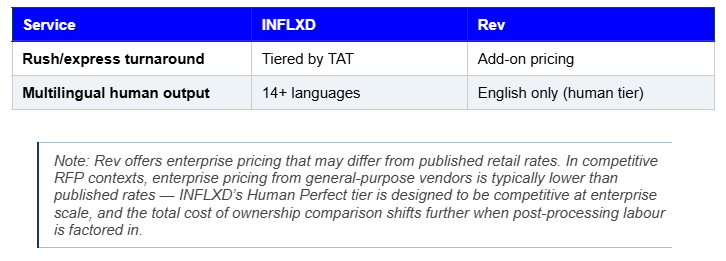
But pricing conversations in enterprise RFPs are not just about the per-minute rate. Procurement leaders consistently tell us the same thing: the real cost is what happens after the transcript arrives. When a transcript requires significant internal editing time — correcting terminology, fixing speaker labels, verifying figures, reformatting output before it is usable in a research product or client deliverable — that internal labour cost compounds fast. INFLXD delivers a compliance-ready, entity-tagged, finished transcript. When total cost of ownership is the lens — and it always is in enterprise procurement — the comparison shifts significantly.
For organisations spending seven figures annually across fragmented vendor relationships (we regularly see expert networks managing 10 to 15 transcription vendors simultaneously), consolidation alone generates meaningful savings before you account for the per-minute differential.
Speed to operational capacity
This is where the conversation gets interesting — and where most vendors fall short in ways that genuinely surprise procurement teams.
When enterprise buyers ask a traditional transcription vendor how long it takes to stand up capacity for 2,000+ hours per month, the answer is often three months or more. We have been in RFP conversations where procurement leads express real frustration with this. The expectation — reasonably — is that if you are buying a service, the provider should be able to deliver without an extended resourcing exercise.
We ramp to full operational capacity in approximately six weeks. That includes style guide training, technical integration, ring-fenced team assignment, and capacity build. This is standard operating procedure for us, not an exception. We currently serve clients whose monthly volumes exceed what most expert networks process in a quarter. Standing up a team for your volume is logistics, not risk.
The structural gaps that matter most in financial services
Multilingual coverage with human verification — expert networks vs. earnings calls
The multilingual challenge plays out differently depending on your use case, and it is worth addressing each directly.
For expert networks: the core issue is code-switching and non-English human-reviewed accuracy. An expert call that shifts mid-conversation from English to Mandarin for technical detail, or from English to French for contextual colour, is not an edge case — it is standard for any firm with global coverage. Most general-purpose transcription platforms require a single language at submission; mixed-language content gets dropped or annotated as "(speaking a foreign language)" rather than transcribed. INFLXD's AI models detect language transitions within a recording, and our human editors validate the switches and transcribe across language boundaries.
For earnings call providers: the issue is coverage consistency and operational simplicity. International earnings calls require human-verified transcription in multiple languages, delivered to consistent quality standards, formatting specifications, and turnaround SLAs. Managing separate vendor relationships per language — each with different quality norms and different failure modes — is operationally unsustainable at scale. INFLXD's 14+ language human-reviewed capability consolidates this into a single vendor relationship with unified quality standards.
Rev offers AI transcription in 37+ languages and global subtitles translating English video into 15+ languages, but their human transcription service is English-only. For compliance-sensitive financial content requiring human-reviewed accuracy in non-English languages, organisations currently need to source a separate solution. INFLXD supports 14+ languages with human-reviewed transcription, eliminating that fragmentation.
We do require minimum volumes for non-English human-in-the-loop transcription, because building a dedicated ring-fenced team for a specific language requires investment in training, management, and quality infrastructure. But for organisations with meaningful non-English volume, the consolidation benefit is substantial.
Compliance architecture built for financial audio
Financial audio regularly contains material non-public information. It is subject to regulatory scrutiny and requires audit trail capabilities that general-purpose transcription platforms were never designed to provide.
INFLXD's compliance infrastructure includes:
- End-to-end AES-256 encryption
- Closed-loop platform — audio cannot be downloaded outside the secure environment
- Chunked transcript delivery — no single editor ever sees a complete document
- Ring-fenced editor teams assigned per client
- MNPI compliance flagging built into the workflow
- Configurable data retention with client-controlled deletion
- Professional liability insurance
General-purpose transcription platforms — built for podcasts, meetings, and media production — typically lack MNPI-specific controls, closed-loop architecture, and the compliance audit trails that financial services firms require. For expert networks, where every call is a potential compliance exposure, this is a risk management question that procurement and legal teams increasingly treat as non-negotiable.
Real-time transcription that self-corrects on financial content
Our proprietary Near Real-Time technology is built for live earnings calls. As a call progresses, the system self-corrects as context accumulates — phonetic approximations resolve to correct company names, speaker labels populate, financial terminology auto-corrects. The output improves continuously rather than requiring manual correction afterwards.
Time to publication is the North Star for many of our financial data provider clients. Whether it is a 1-hour, 4-hour, 12-hour, or 24-hour turnaround window, we price and staff against each tier explicitly — not as an afterthought.
Beyond transcription: what a strategic partner looks like
Enterprise financial firms are not looking for another vendor on a purchase order. The most productive relationships we have — the ones where we have become the exclusive provider — started with transcription and expanded because we understand the entire value chain.
Metadata and entity enrichment
We do not just deliver a transcript. We deliver structured data — named entity recognition with human validation, company mentions disambiguated and tagged (contextually verified, not just keyword-spotted), word-level timestamps enabling audio snippet retrieval, product and brand identification, and location tagging. All of this ships as structured JSON alongside the transcript, ready to feed whatever downstream system you are building — whether that is a client-facing knowledge platform, a RAG pipeline, or an AI search interface.
Compliance workflow augmentation
We provide a first pass on MNPI flagging and content scrubbing — redaction of analyst names, expert names, or other identifiers based on your specific requirements. We are not the compliance team, and we do not take that liability. But we augment the compliance team's workflow meaningfully, so your reviewers are triaging flagged items rather than reading every transcript end-to-end.
Customisation at scale
Every client gets a ring-fenced editor team trained on their specific style guide, their terminology preferences, their formatting requirements. Some clients want analyst names redacted from text but not audio. Some want a table of contents and keyword tagging. Some want tickers associated with every company mention. The ring-fenced model makes this possible because the same editors build institutional knowledge of your content over time — unlike a marketplace model where a different freelancer handles every file.
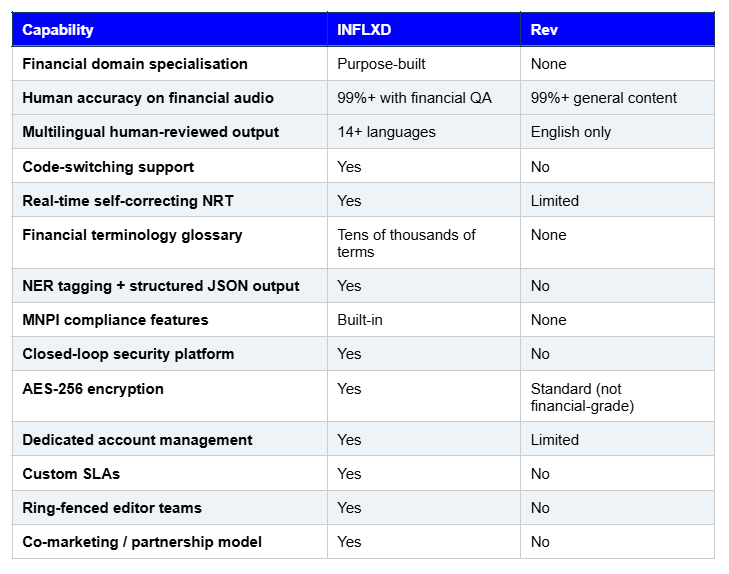
When Rev is the right choice
Rev is a well-executed product for its intended market. If you are transcribing podcasts, internal meetings, media production, or general business content without compliance constraints, Rev is a strong and accessible option. Their AI transcription covers 37+ languages, turnaround is fast, and their platform is polished.
If your transcription needs sit in financial services — expert network calls, earnings transcripts, compliance-sensitive audio, or multilingual financial content at scale — the requirements exceed what general-purpose platforms were designed for. The gaps in domain accuracy, multilingual human-reviewed coverage, compliance infrastructure, and total cost of ownership surface quickly. They surface even faster when tested side by side on the same audio, which is exactly what happens in a formal RFP process.
Frequently asked questions
Is INFLXD cheaper than Rev?
For human transcription, materially so. Enterprise pricing from general-purpose vendors is typically lower than published retail in competitive RFP contexts, and INFLXD is designed to be competitive at that level too. When you factor in the internal editing time that general-purpose transcription output typically requires in financial workflows, the total cost gap widens further.
Does Rev support multilingual transcription for financial services?
Rev offers AI transcription in 37+ languages and global subtitles that translate English video into 15+ languages. However, their human transcription service — which delivers the 99%+ accuracy level — is English-only. For compliance-sensitive financial content requiring human-reviewed accuracy in non-English languages, a separate vendor is needed. INFLXD supports 14+ languages with human-reviewed output, including calls where speakers switch between languages mid-conversation.
What is code-switching and why does it matter?
Code-switching is when speakers move between languages within a single call — starting in English, shifting to Japanese for technical detail, then returning to English. This is routine in global expert networks. Most transcription platforms require you to select a single language at submission and handle mixed-language content poorly. INFLXD's AI models are trained to detect language transitions within a recording, and our human editors validate the switches and transcribe across language boundaries.
What is MNPI transcription compliance?
Material Non-Public Information compliance in transcription refers to the controls that prevent sensitive financial information from being exposed during the transcription process. INFLXD's platform includes MNPI flagging, chunked transcript delivery, ring-fenced editor teams, and a closed-loop environment that prevents audio from leaving the secure platform. These controls are purpose-built for financial services.
How does INFLXD's accuracy compare to Rev on financial audio?
On general content, both platforms can achieve high accuracy. On financial audio — heavy accents, multiple speakers, domain terminology, mixed languages — the gap becomes meaningful. Our QA process is calibrated specifically for financial content, and our editors are trained on the terminology, speaker dynamics, and error categories that matter in this domain. The most reliable way to verify this is to run us against your current vendor on your own audio. Every enterprise client we have won started with that exact test.
How long does onboarding take?
Standard onboarding to full operational capacity takes approximately six weeks. That includes style guide training, technical integration, ring-fenced team assignment, and capacity ramp. This is the same timeline we have executed for the largest expert networks in the space — not aspirational, but proven.
Can you handle seasonal volume spikes?
Earnings season can mean significant surges in daily volumes. Our operational infrastructure is built around this reality. We currently serve clients whose monthly volumes exceed what most expert networks process in a quarter. Seasonal flex is built into how we structure partnerships — not treated as an exception.
Test us on your hardest files
The most reliable way to evaluate any transcription vendor is on your own content — specifically the content that gives your current vendor trouble. Send us five of your most challenging recordings: the ones with heavy accents, mixed languages, dense financial terminology, multiple speakers. We will return them within 24 hours across three quality tiers — AI-only, AI-assisted, and Human Perfect — so you can assess accuracy, formatting, and turnaround directly against what you are getting today.
No commitment. No generic sample audio. No sales process before you see the output.