Otter.ai often comes in discussion of transcription services, and almost always for the same reason: someone on the team has used it to take notes in a Zoom meeting and wondered whether it could handle the firm's expert network calls and earnings recordings too.
It is a reasonable question. Otter.ai is a well-built product with an intuitive interface and strong meeting integration. It is also a consumer and SMB meeting notetaker — and that distinction matters before any procurement conversation goes further.
This page is not a close competitive comparison between two enterprise transcription vendors. It is an explanation of why the category difference between an AI meeting notetaker and a purpose-built financial transcription platform is consequential for expert networks, financial data providers, and compliance-sensitive financial operations — and what to look for instead if Otter.ai has come up in your evaluation.
What Otter.ai is designed to do — and where that design ends
Otter.ai describes itself as an AI meeting agent: it joins Zoom, Google Meet, and Microsoft Teams calls, transcribes in real time, generates automated summaries, extracts action items, and syncs notes to CRM and collaboration tools. Over one billion meetings have been captured on the platform. It is genuinely useful for what it is designed to do — internal meetings, lectures, interviews, and sales calls where the goal is notetaking and follow-up.
The requirements for financial services transcription are structurally different, and the gap between the two is not a configuration issue — it is a product boundary. Here is where that boundary runs:
Language support: 5 languages, one at a time, no code-switching
Otter.ai's own help documentation states clearly that it supports five languages: English (US and UK), Japanese, Spanish, and French. The platform can only transcribe in one language per session — their help documentation notes that users must select the language before a meeting or recording begins, and that multi-language transcribing is a future development goal.
For expert networks where global coverage is a core product requirement, this is a structural constraint rather than a feature gap. An expert call that moves between English and Mandarin, or between English and German, cannot be transcribed by Otter.ai regardless of plan tier. Code-switching — calls that shift language mid-conversation, routine in global expert network content — is not supported. INFLXD supports 14+ languages with human-reviewed transcription and active code-switching detection within a single recording. For expert networks whose content covers Asian, European, and Latin American markets, the language question typically ends the Otter.ai evaluation quickly.
No human review tier — AI-only transcription
Otter.ai does not publicly offer a human-in-the-loop transcription option at any subscription tier. The platform is AI-only: the transcript you receive from Otter is what the model produced, with no human editor pass available. For internal meeting notes — the use case Otter is designed for — this is appropriate. The accuracy bar for a Zoom summary that feeds a CRM and an internal action item list is different from the accuracy bar for a financial transcript that feeds a research product, a published data feed, or a compliance review.
On clean audio in a quiet environment, Otter's AI transcription performs well. Accuracy degrades meaningfully with background noise, heavy accents, and dense technical terminology. Independent reviews consistently note accuracy drops to 60–70% in noisy environments, significant errors on technical terms, and failures with heavy accents. For expert network calls — frequently recorded remotely, often with non-native English speakers, dense with sector-specific terminology — the absence of a human review option is a material quality constraint.
Financial transcription that feeds downstream research products, data feeds, or compliance review is not a meeting notetaking use case. The accuracy bar is fundamentally different, and a platform without a human review tier cannot meet it on challenging content regardless of how good the AI layer is.
Subscription minute caps on uploaded audio
Otter's pricing is structured around subscriptions with monthly minute allocations per user — 300 minutes on the free plan, 1,200 on Pro ($8.33/user/month annually), and 6,000 on Business ($20/user/month annually). Enterprise pricing is custom, averaging approximately $6,300 annually based on Vendr data. The minute caps apply to imported audio files as well as live recordings, and the Pro plan limits imported file counts to 10 per month.
For expert networks processing hundreds of calls per month across multiple clients and languages, subscription minute caps per user create immediate operational problems. The volumes are incompatible with the model. Expert networks do not need per-user meeting minutes — they need platform capacity for batch audio processing that scales with call volume, not headcount. The Otter pricing architecture was designed for a different use case, and that architecture does not flex to match enterprise financial audio workflows.
Compliance architecture designed for meetings, not financial audio
Otter.ai holds SOC 2 Type II certification and, as of mid-2025, achieved HIPAA compliance for healthcare use cases on Enterprise plans. These are appropriate credentials for a meeting platform. The compliance architecture, however, reflects the meeting notetaking use case rather than financial audio handling.
Otter's default sharing model allows transcripts to be shared via public link — a setting that must be explicitly disabled by administrators to avoid unauthorised exposure. Their help documentation notes that link-based transcript sharing is not appropriate when Protected Health Information is involved, and recommends that administrators audit and revoke externally shared content. The burden is on the administrator to configure the platform for sensitive content, rather than the platform being designed for sensitive content by default.
For financial services, the compliance requirements are more specific than SOC 2: MNPI-aware handling of sensitive financial audio, closed-loop architecture that prevents audio from being accessible outside a secure environment, chunked transcript delivery so no individual sees a complete sensitive document, ring-fenced editor teams per client, and configurable data retention with client-controlled deletion. None of these controls are described in Otter.ai's public product documentation. They are not gaps in an otherwise financial-services-ready product — they are characteristics of a platform designed for a different compliance environment entirely.
In August 2025, a federal class-action lawsuit was filed in the US District Court for the Northern District of California alleging that Otter's bot automatically joins meetings without obtaining participant consent. The case centres on allegations of recording private conversations without proper disclosure. This is not a verdict on the platform's security architecture, but it is a buyer risk signal worth noting: a platform whose default behaviours require active administrator intervention to prevent unauthorised sharing, and whose consent model is under active legal scrutiny, requires careful legal review before deployment in a financial services context where audio content regularly contains material non-public information.
Meeting notetaker vs. production financial transcription
Perhaps the most important framing for procurement teams is this: Otter.ai's output is designed to be consumed internally by meeting participants who were on the call. INFLXD's output is designed to be published, sold, or fed into downstream AI workflows by teams who were not on the call. These are different quality and format requirements.
Otter produces meeting summaries, action items, and searchable transcripts — output designed for team follow-up. INFLXD produces structured, human-reviewed transcripts with named entity recognition, speaker labels validated by financial editors, word-level timestamps for audio snippet retrieval, and JSON-ready structured data for knowledge platforms, RAG pipelines, and AI search interfaces. The output from Otter.ai cannot be used as a drop-in replacement for production financial transcription without significant internal processing — which eliminates the cost advantage the lower subscription price appears to offer.
Why enterprise procurement teams in financial services choose INFLXD
Human-reviewed accuracy on financial audio
INFLXD operates a three-layer model: proprietary AI fine-tuned on financial audio, purpose-built financial editing workflows, and a ring-fenced editor team assigned per client. The AI layer processes financial audio before human review begins, resolving the most common financial terminology errors — misheard fund names, incorrect tickers, approximate regulatory language — before an editor sees the file. The human layer then validates entity recognition, verifies speaker labels, confirms figures, and applies client-specific style requirements.
The ring-fenced model is the component that most distinguishes the INFLXD relationship from any subscription platform. The same editors handle the same client's content over time. They accumulate institutional knowledge — your house style, your most-referenced companies, your sector vocabulary, the speaker patterns of your most frequently featured experts. That compounding accuracy effect cannot be replicated by a rotating pool of AI inference with no human layer.
Multilingual financial transcription with code-switching
INFLXD supports 14+ languages with human-reviewed transcription calibrated for financial audio in each. For expert networks with global coverage, code-switching support — detecting and correctly transcribing within a single recording when speakers shift language mid-conversation — is a core capability, not an edge case. Our AI models detect language transitions within a recording and our editors validate the switches and transcribe across language boundaries. The five-language ceiling and one-language-at-a-time constraint of Otter.ai are structural incompatibilities with global expert network operations, not configuration settings.
No minute caps. No per-user seat constraints. No file import limits.
INFLXD's commercial model is built around your audio volume — not headcount, not monthly seat allocations, not import file limits. For an expert network processing 500 calls per month at varying lengths across multiple languages, the total throughput requirement is the commercial variable that matters. We structure partnerships around volume tiers with committed turnaround SLAs, not subscription architectures that create ceiling effects when call volumes spike during earnings seasons or when new research programmes launch.
The comparison with Otter's subscription model is most stark at scale: a 20-person team on Otter Business pays $4,800 annually but is collectively capped at 120,000 minutes per month — a ceiling that sounds generous until an expert network considers that their actual audio processing requirement may be 50,000+ minutes of non-meeting, uploaded, compliance-sensitive content that requires human review and structured output. At that point, the subscription model is both the wrong architecture and the wrong price point.
Compliance-aligned audio architecture
INFLXD's compliance infrastructure is built specifically for financial audio from the ground up:
- End-to-end AES-256 encryption across all audio and transcript handling
- Closed-loop platform — audio cannot be accessed or downloaded outside the secure environment
- Chunked transcript delivery — no individual editor ever sees a complete sensitive document
- Ring-fenced editor teams assigned per client, with access restricted to that client's content
- MNPI flagging built into the editorial workflow
- Configurable data retention with client-controlled deletion
- Professional liability insurance
Legal and compliance review at financial services firms consistently identifies these factors as material during vendor evaluation.
The structural gaps that matter most in financial services
Earnings call transcription requires more than real-time
Otter.ai offers live transcription for meetings — a strong feature for internal collaboration. Financial data providers require something structurally different: near-real-time transcription that self-corrects on financial entity terminology as the call progresses, with publication-ready structured output available within a defined window after call completion.
INFLXD's proprietary Near Real-Time technology is built specifically for live earnings call coverage. As a call progresses, the system continuously self-corrects — phonetic approximations resolve to correct company names, financial instrument names auto-correct as context accumulates, and speaker labels populate dynamically. The output is publication-ready, not meeting-summary-ready. For financial data providers whose earnings call products compete on speed and accuracy, the distinction between a meeting notetaker's live transcription and a financial NRT platform is the difference between a product and a workaround.
Structured output for downstream AI workflows
INFLXD delivers structured data alongside every transcript: named entity recognition with human validation, company mentions disambiguated and contextually verified, word-level timestamps enabling audio snippet retrieval, and structured JSON ready to feed RAG pipelines, knowledge platforms, or AI search interfaces. This is not a supplementary feature — it is the reason financial data providers embed our output in their research products and sell it to institutional clients.
Otter.ai's output is meeting notes: automated summaries, action items, and searchable transcripts. These are designed to be read by meeting participants, not consumed by downstream AI systems. The NER tagging, entity disambiguation, and structured JSON that financial data workflows require are not publicly documented features of Otter.ai's platform.
Expert network workflow support
Expert network transcription has distinct operational requirements that meeting notetakers were not built to address: batch upload of recordings from multiple external interview platforms, custom speaker labelling for expert and analyst roles, compliance review integration, client-specific formatting and delivery, and file-level turnaround SLA management across variable volumes. INFLXD's platform is built around these requirements. Otter.ai's platform is built around calendar integration, meeting bot deployment, and team collaboration — a fundamentally different workflow.
Side-by-side comparison
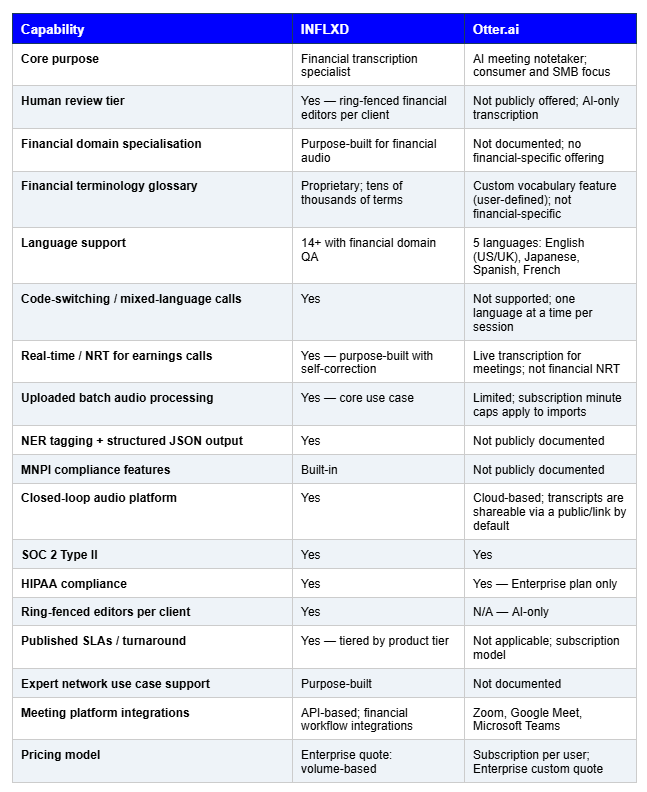
Otter.ai holds SOC 2 Type II and HIPAA compliance (Enterprise tier). 'Not publicly documented' entries reflect capabilities not described in Otter.ai's public website, help documentation, or pricing pages as of early 2026. Buyers should verify directly with Otter.ai for any capabilities they require. Language support sourced from Otter.ai's own help centre documentation (November 2025 update).
When Otter.ai is the right choice
Otter.ai is a well-built product for its designed use case, and that use case is substantial. If your organisation needs real-time transcription for internal meetings across Zoom, Google Meet, and Microsoft Teams, AI-generated summaries with action item extraction, CRM sync for sales call notes, and searchable meeting archives for a team that works primarily in English — Otter.ai is a strong, cost-effective option that is easy to deploy and simple to use.
The comparison shifts when the requirement is production financial transcription. Expert network call processing, earnings call coverage, MNPI-sensitive audio handling, multilingual human-reviewed output, and structured data for downstream AI workflows require a different product category. Otter.ai's five-language ceiling, AI-only transcription, subscription minute caps, and meeting-oriented compliance architecture are not gaps that can be addressed by upgrading to a higher plan — they reflect the fundamental design choices of a meeting notetaker built for a different market.
The most common scenario in which Otter.ai comes up in financial services vendor evaluations is also the most instructive: someone has a positive personal experience with the tool for internal meetings and wonders if it scales to the firm's financial audio. The answer is that it scales to more meetings. It does not scale to a different use case.
Frequently asked questions
What is Otter.ai actually designed for?
Otter.ai is an AI meeting notetaker designed for internal team meetings across Zoom, Google Meet, and Microsoft Teams. Its core value proposition is real-time transcription, automated meeting summaries, action item extraction, and CRM integration for follow-up workflows. It serves students, freelancers, sales teams, and general enterprise meeting users. It is not designed for production financial transcription, expert network audio processing, or MNPI-sensitive financial audio.
How many languages does Otter.ai support?
As of November 2025 per Otter's own help documentation, the platform supports five languages: English (US and UK regional accents), Japanese, Spanish, and French. Crucially, the platform can only transcribe in one language per session — users must select their language before recording begins. Code-switching (calls that shift between languages mid-conversation) is not supported. INFLXD supports 14+ languages with human-reviewed transcription and code-switching detection within a single recording.
Does Otter.ai have a human transcription option?
Otter.ai does not publicly offer a human review tier at any subscription level. The platform is AI-only. For expert network calls with heavy accents, dense financial terminology, and multiple speakers, the absence of a human review option is a quality constraint that cannot be addressed by plan tier. INFLXD's ring-fenced editor model provides human-reviewed transcription on every file, with editors trained specifically on financial audio and calibrated to the error categories that create downstream risk in financial research products.
Is Otter.ai compliant enough for financial services?
Otter.ai holds SOC 2 Type II certification and, as of mid-2025, HIPAA compliance for Enterprise customers. For internal meeting notes, these credentials are appropriate. For financial audio containing material non-public information, the compliance requirements are more specific: MNPI-specific controls, closed-loop audio architecture, chunked delivery preventing any single individual from seeing a complete sensitive document, and ring-fenced editor access. None of these are described in Otter.ai's public product documentation. Additionally, Otter's default sharing settings allow public link-based transcript access, which requires active administrator configuration to restrict — a design that is the inverse of what financial services compliance environments require.
Can Otter.ai handle expert network call volumes?
Expert networks typically process hundreds of calls per month across multiple languages, clients, and external recording platforms. Otter.ai's subscription model — with per-user monthly minute allocations and file import caps — is architected for meeting-by-meeting team use, not batch financial audio processing at scale. The Business plan at $20/user/month annually provides 6,000 minutes per user per month — a structure that creates cost and operational friction for organisations whose transcription requirement is platform throughput rather than individual user capacity. INFLXD's volume-based commercial model is built specifically for the batch processing scale that expert networks require.
What about the 2025 consent lawsuit?
In August 2025, a federal class-action lawsuit was filed in the US District Court for the Northern District of California alleging that Otter.ai's bot automatically joins meetings without obtaining participant consent. The case is ongoing, and we draw no legal conclusions from it — that determination is for the courts. What it represents for procurement teams is a buyer risk signal: a vendor whose default deployment method (automatic meeting bot joining) is under active legal scrutiny for consent compliance requires additional due diligence before deployment in a financial services context where recordings contain MNPI and participant consent is a compliance requirement. Buyers should review Otter's current terms, data processing agreements, and default configuration settings with their legal team before any enterprise deployment.
How quickly can INFLXD onboard compared to a subscription tool?
Otter.ai can be deployed by an individual user in minutes. INFLXD onboards new enterprise clients to full operational capacity in approximately six weeks — style guide training, technical integration, ring-fenced team assignment, and capacity build. The comparison is not meaningful as a competitive disadvantage: a meeting notetaker that an individual can activate independently is solving a different problem than an enterprise financial transcription partnership with ring-fenced editors, custom glossaries, MNPI controls, and committed SLAs. If the requirement is the latter, the six-week ramp is the path to a fundamentally better-quality outcome than a self-serve subscription can deliver.
Test us on your hardest files
If Otter.ai has come up in your evaluation and you are trying to assess whether a purpose-built financial transcription platform genuinely delivers a different outcome, the fastest way to find out is to test both on the same content. Send us five of your most challenging recordings: heavy accents, mixed languages, dense financial terminology, multiple speakers. We will return them within 24 hours across three quality tiers — AI-only, AI-assisted, and Human Perfect — so you can assess accuracy, formatting, and turnaround directly against what you are currently getting.
No commitment. No generic sample audio. No sales process before you see the output.