If Kensho Scribe is on your shortlist for financial audio transcription, you are looking at a legitimately strong product. Kensho, the AI innovation arm of S&P Global, built Scribe on more than 180,000 hours of professionally curated financial audio. For English-language financial transcription at scale, it sits at or near the top of the AI-first vendor category. We acknowledge that clearly because anything less would be dishonest, and procurement teams at expert networks and financial data providers can tell the difference between a genuine comparison and a marketing document.
We write this having sat across the table from Kensho Scribe in formal RFP evaluations. What follows is where the comparison gets specific: the documented gaps between a strong English-language AI transcription engine and a multilingual, human-in-the-loop financial transcription platform built for the full complexity of what expert networks and financial data providers actually process day-to-day.
For some financial services buyers, Kensho Scribe is the right choice. For others — particularly those with multilingual audio volume, expert network workflows, MNPI compliance requirements, or real-time earnings call coverage needs — the structural differences matter. This page is designed to make those differences clear.
Where Kensho Scribe's design choices create boundaries for some financial workflows
Kensho Scribe is an AI-first transcription engine with an optional human-in-the-loop tier. It was built to serve S&P Global's internal transcription needs — earnings calls, management presentations, acquisition calls — and then opened to external clients. That origin is genuinely valuable: the training corpus reflects real financial audio at institutional scale. But that same design history creates specific product boundaries that surface in enterprise procurement when the buyer's workflow extends beyond English-language recorded financial content.
Output is English-only — including for non-English input.
This is the most consequential documented constraint for expert networks. Kensho's own developer documentation states explicitly: “The output will always be in English.” For non-English input, the HITL pipeline translates the audio to English before producing the transcript. There is no multilingual transcript output — in the source language, with human review — documented anywhere in Kensho's public product materials.
For expert networks with meaningful non-English call volume, this is a hard product boundary. A Mandarin expert call that needs to be delivered to a client as a Mandarin transcript — preserving the source language for downstream NLP processing, entity recognition in Chinese, or review by Mandarin-reading analysts — cannot be delivered in that form by Kensho Scribe. For earnings call providers covering international companies whose IR teams conduct calls in Japanese, Korean, French, or Portuguese, the same constraint applies. Every non-English audio file produces an English output, not a transcript in the source language.
Real-time and near-real-time transcription is not publicly documented.
Kensho Scribe's documented turnaround options are 8, 12, and 24 hours — the specific mapping depends on the client's contract. Scribe AI (the automated tier) is faster, but Kensho does not publicly document a self-correcting near-real-time capability designed for live earnings call coverage, where the transcript self-corrects on financial entity terminology as context accumulates during the call and a publication-ready output is available within minutes of call completion.
For financial data providers whose products depend on fast earnings call coverage — same-session or sub-hour publication — the absence of a documented NRT capability is a product boundary rather than a configuration question. Time to publication is among the most commercially sensitive metrics for clients in this segment, and it is rarely satisfied by a contracted 8-hour minimum turnaround.
Client-specific terminology customisation is constrained in the human tier.
Kensho Scribe AI supports hotwords — custom terminology that the AI model prioritises during transcription. Kensho's own developer documentation notes that in the HITL tier, the hotwords option is explicitly ignored, because human editors are doing the correction. What is not publicly documented is whether HITL editors have access to per-client terminology glossaries, style guides, or formatting specifications that persist across files — the kind of ring-fenced institutional knowledge that builds up over time when the same editors work consistently on the same client's content. For financial data providers with specialised vocabulary, custom entity taxonomies, or specific formatting requirements, this distinction matters.
Vendor relationship with S&P Global warrants a data governance conversation.
Kensho is a wholly owned subsidiary of S&P Global, one of the world's largest financial data and analytics companies. S&P Global is also a significant competitive intelligence gatheholder in financial markets. We raise this not as a criticism — S&P Global is a respected and regulated financial institution with robust data handling policies — but because it is a question that routinely surfaces in procurement and legal review at financial services firms when evaluating transcription vendors.
Expert networks and financial data providers regularly process audio containing competitive intelligence, pre-publication research, MNPI-adjacent content, and sensitive client information. Whether routing that audio through an S&P Global subsidiary creates data governance considerations — information barriers, potential conflict of interest review, or simply internal risk assessment requirements — is a question that the legal and compliance teams at buying organisations will ask. It is worth having the answer before the vendor reaches the legal review stage of a procurement process.
Why enterprise procurement teams in financial services choose INFLXD
When Kensho Scribe appears on the same shortlist as INFLXD, the evaluation almost always comes down to the same questions: what happens on non-English audio, how does the real-time coverage requirement get met, and what are the compliance implications of the vendor relationship. Here is how the comparison plays out on each.
Multilingual human-reviewed output across 14+ languages
INFLXD supports 14+ languages with human-reviewed transcription — meaning native-language editors with financial domain training, not AI translation to English. For an expert call conducted in Mandarin, the transcript is delivered in Mandarin. For a Korean earnings call, the output is in Korean. This is not a translation service layered on top of English transcription; it is human-reviewed financial transcription in the source language.
For expert networks processing global calls, this distinction determines whether a single vendor can cover the full audio estate, or whether a separate vendor relationship is required for every non-English language. Managing 10 or 15 transcription vendor relationships — each with different quality norms, different turnaround SLAs, and different formatting conventions — is operationally expensive in ways that do not appear in a per-minute rate comparison.
We also support code-switching — calls where speakers shift between languages mid-conversation, which is routine in global expert networks. Our AI models detect language transitions, and our human editors validate and transcribe across language boundaries in a single document. This capability is not publicly documented for Kensho Scribe.
Total cost of ownership, not the per-minute rate
Neither INFLXD nor Kensho Scribe publishes retail pricing — both are quote-based. The more meaningful comparison is what happens after the transcript arrives. Kensho Scribe AI delivers fast, financially-trained machine output that will require post-processing for some content types: speaker labeling validation, entity verification, formatting to client specifications, and correction of any terminology the model did not resolve correctly. Scribe HITL adds human review but — as noted above — the hotwords option is ignored in the human tier, and per-client glossary persistence is not publicly documented.
INFLXD delivers a compliance-ready, entity-tagged, formatted transcript from a ring-fenced team with cumulative institutional knowledge of your content. When procurement teams calculate total cost of ownership — factoring in the internal analyst time required to process and validate transcripts before they are usable in research products — the comparison shifts.
For clients already subscribing to S&P Global data products, the Kensho Scribe relationship may sit naturally within an existing commercial arrangement. Buyers should evaluate whether that bundling creates commercial leverage or constrains the ability to run competitive evaluations independently.
Speed to operational capacity
For financial data providers requiring NRT coverage — live or near-live earnings call transcription — INFLXD's proprietary Near Real-Time technology is purpose-built for that use case. As a call progresses, the system self-corrects: phonetic approximations resolve to correct company names, speaker labels populate, financial terminology auto-corrects as context accumulates. Publication-ready output is available within minutes of call completion, not hours.
For recorded content, our turnaround SLAs are structured around the same time-to-publication tiers that financial data providers operate against: 1-hour, 4-hour, 12-hour, and 24-hour windows, each explicitly priced and staffed. We ramp to full operational capacity for a new enterprise client in approximately six weeks, including ring-fenced team assignment, style guide training, and technical integration.
The structural gaps that matter most in financial services
Multilingual output — source language vs. English translation
For expert networks: the core issue is source-language transcript delivery. Kensho Scribe's documented architecture translates non-English audio to English output. For clients whose downstream workflows depend on source-language transcripts — NLP processing in Chinese, entity recognition in Japanese, review by analysts who read in Korean — English-only output does not solve the problem. INFLXD delivers human-reviewed transcripts in the source language across 14+ languages, including code-switching within a single recording.
For earnings call providers: the issue is coverage completeness and quality consistency. International earnings calls require transcript output in the language of the call — not an English translation — to serve IR teams, local analysts, and multilingual research products. INFLXD's multilingual human-reviewed capability is built around unified financial quality standards and consistent turnaround SLAs, regardless of the source language.
MNPI scrubbing architecture
Financial audio containing material non-public information requires compliance controls that go beyond general enterprise security. INFLXD's compliance infrastructure includes:
- End-to-end AES-256 encryption
- Closed-loop platform — audio cannot be downloaded outside the secure environment
- Fully chunked transcript delivery — no individual sees a complete document at any stage
- Ring-fenced editor teams assigned per client
- MNPI compliance flagging built into the workflow
- Configurable data retention with client-controlled deletion
- Professional liability insurance
Kensho Scribe's public security documentation describes in-house employees who have signed confidentiality agreements and attended security training, and notes more than 10 years of experience handling sensitive documents. MNPI-specific flagging, closed-loop audio architecture, and chunked delivery designed to prevent any individual from seeing a complete sensitive document are not described in their public product materials. For expert networks and financial data providers where MNPI exposure is a daily operational reality, these controls are increasingly treated as baseline requirements in vendor procurement.
Real-time transcription for live earnings coverage
INFLXD's proprietary Near Real-Time technology self-corrects as a live call progresses — resolving financial entity terminology, populating speaker labels, and producing a publication-ready transcript within minutes of call completion. This is designed specifically for the time-to-publication requirements of financial data providers whose earnings call products compete on speed.
Kensho Scribe does not publicly document a real-time or near-real-time capability. Their documented minimum HITL turnaround is 8 hours under contract. For Scribe AI, turnaround is faster, but a self-correcting, live financial entity recognition system producing sub-hour output from live call audio is not described in their public product materials.
Beyond transcription: what a strategic partner looks like
The most productive vendor relationships in financial data are not file-in, transcript-out transactional arrangements. They are partnerships where the vendor understands the downstream value of the content they are processing. Here is where that distinction becomes concrete.
Metadata and entity enrichment
INFLXD delivers structured data alongside every transcript: named entity recognition with human validation, company mentions disambiguated and contextually verified, word-level timestamps enabling audio snippet retrieval, and structured JSON ready to feed RAG pipelines, knowledge platforms, or AI search interfaces. Kensho does offer a separate NER product — Kensho NERD — which connects entities to Capital IQ and Wikimedia knowledge bases. NERD is a standalone product, not bundled with Scribe output by default. Buyers should clarify whether and how the two products integrate in their specific commercial arrangement.
Compliance workflow augmentation
We provide a first pass on MNPI flagging and content scrubbing — redaction of analyst names, expert names, or other identifiers based on your specific requirements. We augment the compliance team's workflow meaningfully, so your reviewers are triaging flagged items rather than reading every transcript end-to-end. This is not a capability we have found documented in Kensho Scribe's public product materials.
Customisation at scale
Every INFLXD client gets a ring-fenced editor team trained on their specific style guide, terminology preferences, and formatting requirements — and the same editors accumulate institutional knowledge of that client's content over time. Kensho Scribe's HITL tier uses in-house transcriptionists and editors with financial domain training, which is a meaningful advantage over freelancer-pool models. Whether those editors are ring-fenced per client and whether per-client style guides and terminology preferences persist across files is not described in their public documentation.
Side-by-side comparison
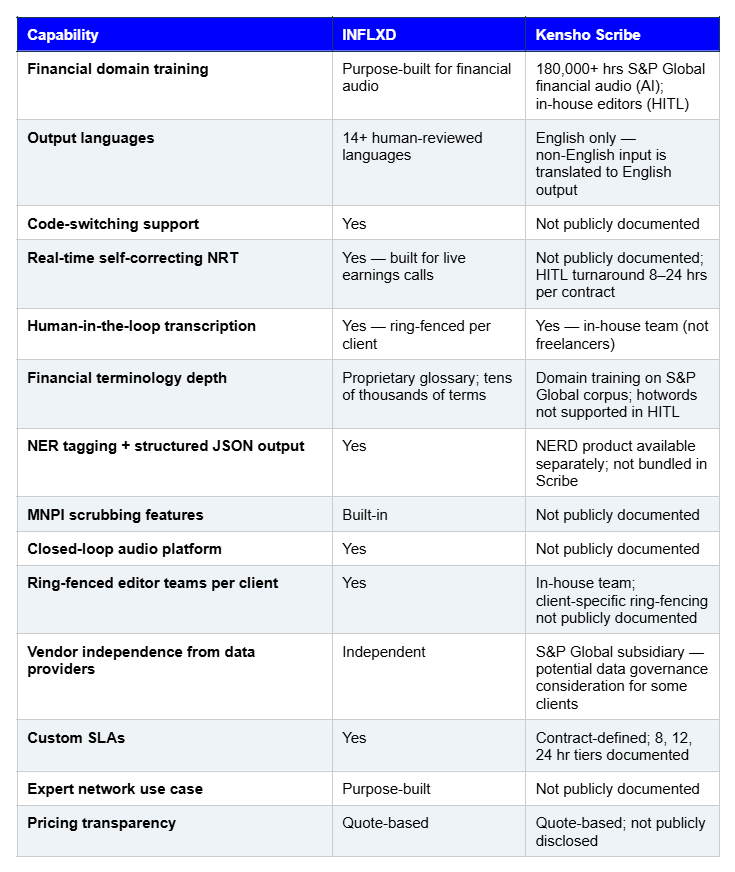
When Kensho Scribe is the right choice
Kensho Scribe is a genuinely strong product for high-volume English-language financial audio transcription. If your organisation primarily processes earnings calls, management presentations, and acquisition calls conducted in English — and your downstream workflows consume English transcripts — Kensho Scribe's domain-trained AI is among the most accurate options available. Trained on S&P Global's own institutional corpus of financial audio, it handles the terminology, accents, and speaker dynamics of English financial audio better than most general-purpose transcription engines.
For organisations already embedded in the S&P Global data ecosystem — Capital IQ subscribers, Compustat users, clients of S&P Market Intelligence — the commercial convenience of a Kensho Scribe relationship within an existing vendor arrangement may outweigh the product-level gaps, depending on whether multilingual output, NRT coverage, or MNPI-specific compliance controls are requirements rather than preferences.
Where the comparison shifts decisively toward INFLXD is when the audio estate is multilingual, when real-time or sub-hour turnaround is a product requirement, when MNPI compliance controls are a legal or procurement baseline, or when expert network workflows require source-language transcript delivery. In those scenarios, the English-only output constraint and the absence of documented NRT and MNPI features are not configurable — they are product boundaries.
Frequently asked questions
What is Kensho Scribe and who is it designed for?
Kensho Scribe is the transcription product of Kensho Technologies, the AI innovation arm of S&P Global. It was originally built to handle S&P Global's internal transcription of earnings calls, management presentations, and acquisition calls — and was subsequently made available to external clients. It offers both an AI-automated tier and a human-in-the-loop tier staffed by in-house editors with financial domain training. It is designed primarily for high-volume English-language financial audio.
Does Kensho Scribe support multilingual transcription?
Kensho Scribe accepts non-English audio input and can produce English output from it via translation before transcription. Kensho's own developer documentation states that the output will always be in English, regardless of input language. There is no documented capability to produce a transcript in the source language for non-English audio. For expert networks or earnings call providers requiring human-reviewed transcripts in the source language — Mandarin, Japanese, Korean, French, or others — this is a documented product boundary.
What is code-switching and does Kensho Scribe support it?
Code-switching is when speakers move between languages within a single call, which is routine in global expert network audio. Kensho Scribe's public documentation does not describe support for code-switching. INFLXD's AI models detect language transitions within a recording, and our human editors validate and transcribe across language boundaries in a single document — delivering a complete transcript that reflects the full content of the call, regardless of which language each segment was conducted in.
How does Kensho Scribe's compliance posture compare to INFLXD's for expert networks?
Kensho Scribe's documented security includes in-house editors under confidentiality agreements with security training, and more than a decade of experience handling sensitive financial documents. MNPI-specific flagging, closed-loop audio architecture, chunked delivery preventing any individual from seeing a complete document, and ring-fenced editor teams per client are not described in their public product materials. Additionally, buyers at expert networks and financial data providers should consider whether routing sensitive audio through an S&P Global subsidiary raises data governance questions that require internal legal review — not because S&P Global's handling is unsound, but because the vendor relationship itself may require assessment given S&P Global's position in the financial data market.
Can Kensho Scribe deliver real-time or near-real-time earnings call transcription?
Kensho's documented HITL turnaround options are 8, 12, and 24 hours, depending on contract terms. Scribe AI is faster, but a self-correcting near-real-time capability — where the transcript self-corrects on financial entity terminology as a live call progresses and publication-ready output is available within minutes of call completion — is not described in their public product materials. INFLXD's proprietary NRT technology is purpose-built for this use case.
How does the NERD entity recognition product relate to Scribe?
Kensho NERD is a separate Kensho product that identifies companies, people, places, and events in text and connects them to Capital IQ and Wikimedia knowledge bases. It is not bundled with Scribe output by default. Whether and how NERD integrates with Scribe transcripts in a given commercial arrangement should be confirmed directly with Kensho. INFLXD delivers NER with human validation — company mentions disambiguated and contextually verified — as part of the standard transcript output, alongside structured JSON for downstream systems.
What if we are already an S&P Global customer — does that make Kensho Scribe the natural choice?
Existing S&P Global relationships may create commercial convenience — procurement is simpler, billing is consolidated, and the vendor is already through your security review process. Whether that convenience outweighs the product-level differences depends on your specific requirements. If your audio estate is predominantly English, your downstream workflows consume English transcripts, and real-time or NRT coverage is not a requirement, the commercial convenience of a bundled Kensho relationship may be compelling. If any of those conditions do not hold — multilingual audio, source-language output requirements, NRT, MNPI compliance controls, or expert network workflows — those product boundaries remain regardless of the commercial arrangement.
Test us on your hardest files
The most reliable way to evaluate any transcription vendor is on your own content — specifically the content that gives your current vendor trouble. Send us five of your most challenging recordings: non-English calls, code-switching audio, dense financial terminology, multiple speakers. We will return them within 24 hours across three quality tiers — AI-only, AI-assisted, and Human Perfect — so you can assess accuracy, language fidelity, and turnaround directly against what you are getting today.
No commitment. No generic sample audio. No sales process before you see the output.